

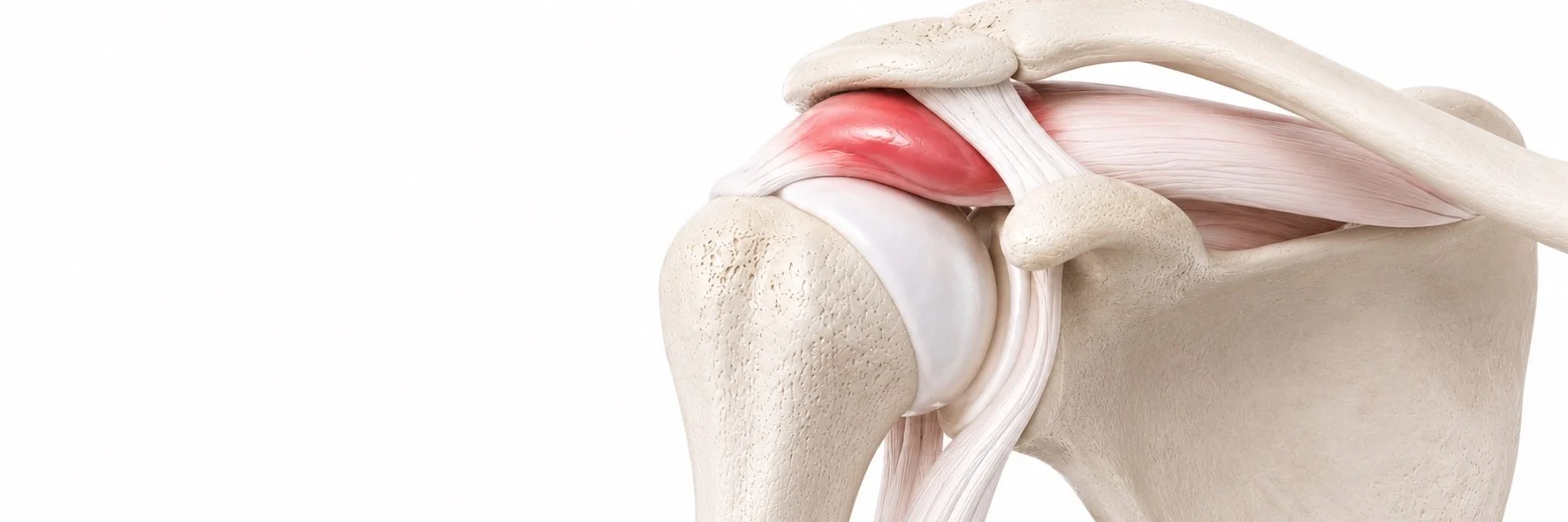

Shoulder pain that wakes you at night is very common, and in most cases it comes from the tendons around the shoulder or from a stiff, inflamed joint capsule. These problems are rarely dangerous and usually respond to treatment without surgery. A few warning signs, listed below, mean the shoulder should be checked promptly.
Key points
- Pain at night, especially when lying on the affected side, is a typical feature of rotator cuff problems and of frozen shoulder.
- Most causes are not dangerous and respond to non-surgical treatment such as physiotherapy, and sometimes an injection.
- If shoulder pain from tendon irritation is not improving after about 12 weeks of non-surgical treatment, a specialist assessment is advised.
- Shoulder pain after an injury, with fever, with a lump, or in a child needs prompt medical assessment.
- Neck problems can also cause pain felt in the shoulder, which is one reason an examination matters.
Why the shoulder hurts at night
Lying on the painful side compresses the irritated tissues, and when you are still there is little to take your mind off the pain. Some conditions also cause pain at rest, which tends to be noticed most at night.
The most common causes
Rotator cuff problems
The rotator cuff is a group of tendons that holds the shoulder in place and helps lift and turn the arm. Irritation of these tendons under the bony roof of the shoulder (often called impingement or subacromial pain) is one of the most frequent causes of shoulder pain. A rotator cuff tear typically causes pain at rest and at night, especially when lying on the affected shoulder, together with pain and sometimes weakness when lifting the arm.
Frozen shoulder
In frozen shoulder, the lining of the joint becomes inflamed and then thickens and tightens. The pain is often severe, including at night, and is followed by stiffness, particularly when turning the arm outwards. It is more common in people with diabetes. Frozen shoulder runs through phases of pain, stiffness and recovery, and can last for well over a year without treatment.
Other causes
- Calcific tendonitis: a calcium deposit within a rotator cuff tendon (calcific tendonitis).
- Arthritis of the shoulder joint: pain with a gradual loss of movement in older patients (shoulder osteoarthritis).
- Pain from the neck: problems in the neck can be felt in the shoulder. This is one reason a proper examination matters.
How the cause is found
The history and a careful examination are the most useful steps: where the pain is, what movements provoke it, whether the shoulder is weak, and whether movement is lost when the arm is moved for you, not just when you move it yourself. A loss of passive movement points towards frozen shoulder or arthritis, while pain and weakness on lifting point towards the rotator cuff.
X-rays are used to look for arthritis and, in a suspected frozen shoulder, to rule out other joint problems. An ultrasound or MRI scan is useful when a tendon tear is suspected or when surgery is being considered.
What helps
For better sleep: - Avoid lying on the painful side. - Try sleeping on your back with a pillow under the arm, or on the other side hugging a pillow to support the painful arm. - Take pain relief before bed if your doctor has advised it.
Treatment: - Physiotherapy is the first-line treatment for pain from the rotator cuff tendons. Guidelines describe this type of pain as usually self-limiting. - A steroid injection may be considered if there is no improvement after 6 to 8 weeks. It is also a standard early option in frozen shoulder. - Specialist referral is advised if there is no improvement after about 12 weeks of non-surgical treatment. - Surgery, such as shoulder arthroscopy or rotator cuff repair, is considered for specific problems or when non-surgical treatment has not worked.
- the pain started after a fall or injury, or the shoulder looks deformed
- fever, or a shoulder that is hot, red and swollen
- a new lump or swelling
- pain with feeling generally unwell, night sweats or unexplained weight loss
- sudden weakness, so that you can no longer lift the arm
When to see an orthopaedic surgeon
See a specialist if night pain is affecting your sleep for more than a few weeks, if pain or weakness is getting worse, or if non-surgical treatment has not helped after around three months. A clinical examination, sometimes with an X-ray, ultrasound or MRI, usually identifies the cause and the right treatment.
Frequently asked questions
Why does my shoulder hurt more at night?
Lying on the painful side puts pressure on the irritated tendons, and at rest there are fewer distractions from the pain. In frozen shoulder the pain can be severe at night even without lying on it.
Which sleeping position is best for a painful shoulder?
Avoid lying on the painful side. Many people find it easier on their back with a pillow under the arm, or on the other side hugging a pillow so the painful arm is supported.
Do I need a scan?
Not always. Often the history and examination point to the cause. X-rays help when arthritis or frozen shoulder is suspected, and an ultrasound or MRI is useful when a tendon tear is likely or when surgery is being considered.
Will a steroid injection help?
It can. For pain from irritated rotator cuff tendons, an injection may be considered if there is no improvement after 6 to 8 weeks. It is also one of the standard early treatments for frozen shoulder. An injection eases pain and works best alongside exercises.
Can shoulder pain at night be something serious?
Usually it is not. But see a doctor promptly if the pain followed an injury or a fall, if you have a fever or the shoulder is hot and red, if there is a new lump, or if you feel generally unwell or are losing weight.
References
- Pandey RA, Singh HP, on behalf of the BESS Subacromial Pain Working Group. BESS Patient Care Pathway: Subacromial Pain. Shoulder Elbow 2025;17(6):713-724. doi:10.1177/17585732251374282
- Rangan A, Gibson J, Brownson P, Thomas M, Rees J, Kulkarni R. BESS/BOA Patient Care Pathways: Frozen Shoulder. Shoulder Elbow 2015;7(4):299-307. doi:10.1177/1758573215601779
- Thomas M, Bidwai A, Rangan A, Rees JL, Brownson P, Tennent D, Connor C, Kulkarni R. Glenohumeral osteoarthritis. Shoulder Elbow 2016;8(3):203-214. doi:10.1177/1758573216644183
- American Academy of Orthopaedic Surgeons (Aibinder WR; peer-reviewed by Mulcahey MK). Rotator Cuff Tears. OrthoInfo https://www.orthoinfo.org/diseases--conditions/rotator-cuff-tears
This article is general patient information. It does not replace an individual medical assessment, diagnosis or treatment. If you have symptoms, please see a doctor.