

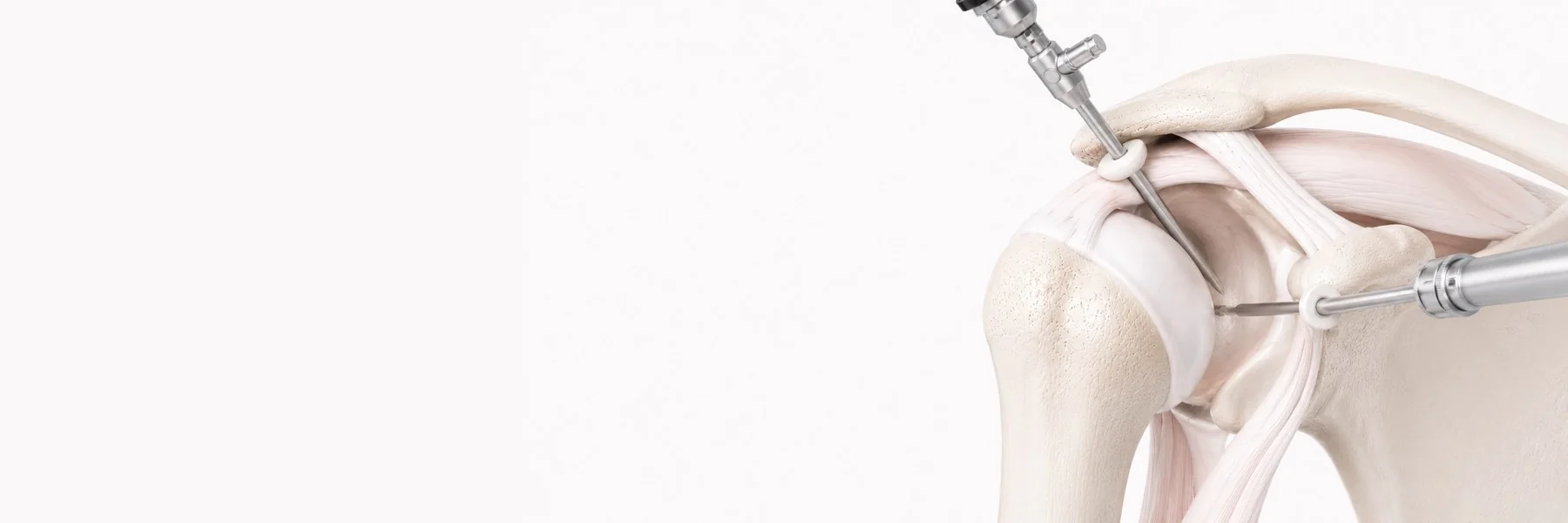
What is shoulder arthroscopy?
Shoulder arthroscopy is a minimally invasive surgical technique that allows me to operate inside the shoulder through small incisions (portals), each approximately 5–10 mm long. A specialised camera (the arthroscope) provides a clear, magnified view of the joint and the surrounding spaces, while specialised precision instruments are used to perform the procedure.
It is the most widely used arthroscopic technique in the upper limb and the platform for a broad range of procedures, from rotator cuff repair to labral surgery to capsular release.
When is shoulder arthroscopy needed?
Common indications include:
- rotator cuff tears requiring repair
- subacromial impingement that has failed conservative treatment
- shoulder instability requiring Bankart or capsular repair
- SLAP lesions and biceps pathology
- calcific tendonitis when conservative measures have failed
- refractory frozen shoulder requiring capsular release
- loose bodies inside the joint
- biopsy or treatment of synovial pathology
How is the operation performed?
A typical shoulder arthroscopy involves:
- general anaesthesia, often combined with a regional block for postoperative pain control
- positioning in the beach-chair or lateral decubitus position
- two to four small portals, typically posterior, anterior and lateral
- systematic diagnostic inspection of the glenohumeral joint and the subacromial space
- the specific therapeutic procedure required (cuff repair, labral surgery, decompression, release)
- closure with sutures, with a sling fitted before waking for most procedures
What should the patient expect after surgery?
Recovery depends on the specific procedure performed:
- most shoulder arthroscopies are performed as day cases
- after simple decompression or diagnostic arthroscopy: sling for comfort only, early mobilisation within days
- after rotator cuff repair or stabilisation: sling for 4–6 weeks with graduated physiotherapy
- regional block manages early pain; oral analgesia is usually sufficient afterwards
- return to driving, work and activity is matched to the specific procedure
What is the long-term outcome?
Outcomes depend almost entirely on the procedure performed arthroscopically, not on the arthroscopy itself. Specific procedures are discussed in detail on their respective service pages.