

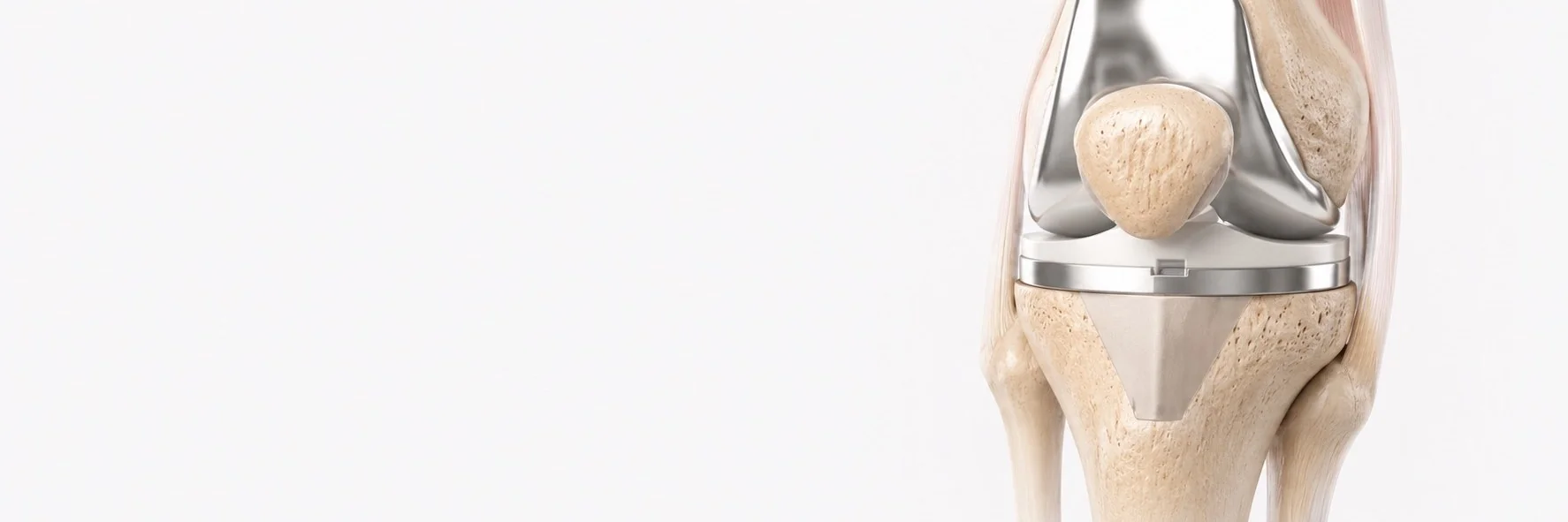
What is total knee replacement?
Total knee replacement (TKR) is one of the most successful operations in modern orthopaedics. The damaged surfaces of the femur, tibia and (where appropriate) the patella are replaced with metal and polyethylene components designed to reproduce the geometry and function of a healthy knee.
For patients with end-stage knee disease, TKR reliably relieves pain and restores function.
When is total knee replacement necessary?
TKR is considered when:
- advanced osteoarthritis involving more than one compartment of the knee
- rheumatoid arthritis or other inflammatory joint disease with severe joint destruction
- post-traumatic arthritis after fracture or significant injury
- avascular necrosis with collapse of the joint surface
- failure of previous joint-preserving procedures
The decision is made when:
- pain is no longer adequately controlled with conservative treatment
- function is significantly compromised, limp, sleep disturbance, inability to perform daily activities
- radiographs demonstrate advanced joint destruction
How is the operation performed?
I perform total knee replacement using modern anatomically designed implants and evidence-based surgical techniques. During the procedure, the worn surfaces of the femur, tibia, and, where indicated, the patella are carefully prepared before the implants are positioned to restore limb alignment, knee stability, and balanced soft tissues.
When clinically appropriate, I perform robotic-assisted total knee replacement. Robotic technology enables highly accurate bone preparation and implant positioning based on each patient's individual anatomy, while providing real-time intraoperative data to help optimise alignment and soft tissue balance. Depending on the clinical scenario, computer navigation and patient-specific cutting guides may also be used to further personalise the procedure.
What types of total knee replacement exist?
- cruciate-retaining (CR), preserves the posterior cruciate ligament
- posterior-stabilised (PS), substitutes for the PCL with a post-cam mechanism
- medial-pivot designs, restore a more physiological pattern of knee kinematics
- rotating-platform, mobile-bearing designs in selected cases
- constrained or hinged implants for severe deformity, instability or revision cases
Implant choice is individualised based on the patient's anatomy, the state of the ligaments, the deformity, and the activity level.
Cemented or cementless fixation?
Both options have a place in modern knee replacement:
- cemented fixation, the established standard, with decades of excellent results, and the fixation method I most commonly use
- cementless fixation, biological fixation through biological bone ingrowth, suitable for younger and active patients with good bone quality
I select the fixation method based on patient age, bone quality, and the specific implant design.
What should the patient expect after surgery?
- mobilisation begins on the day of surgery or the next day
- hospital stay is typically 2–4 days
- walking aids (crutches or a walker) for 2–6 weeks
- driving usually resumes at 4–6 weeks
- return to office-based work at 4–8 weeks, and to more physically demanding work at approximately 3 months
- return to low-impact recreational activities (cycling, swimming, golf) at 3 months
- high-impact sports such as running and jumping are not recommended after knee replacement
How important is rehabilitation?
Rehabilitation is essential for a successful knee replacement outcome. The early weeks focus on regaining motion (particularly extension) and quadriceps activation. Strengthening progresses gradually during the following months. Final recovery, including the resolution of swelling and the return of full strength, typically takes 6–12 months.
What is the long-term outcome?
Total knee replacement has excellent and well-documented long-term outcomes:
- patient satisfaction routinely exceeds 85% in modern studies
- implant survivorship at 15 years exceeds 90% in most national joint registries
- many modern implants last 25 years or longer
- the great majority of patients regain pain-free walking and return to the activities that matter to them