

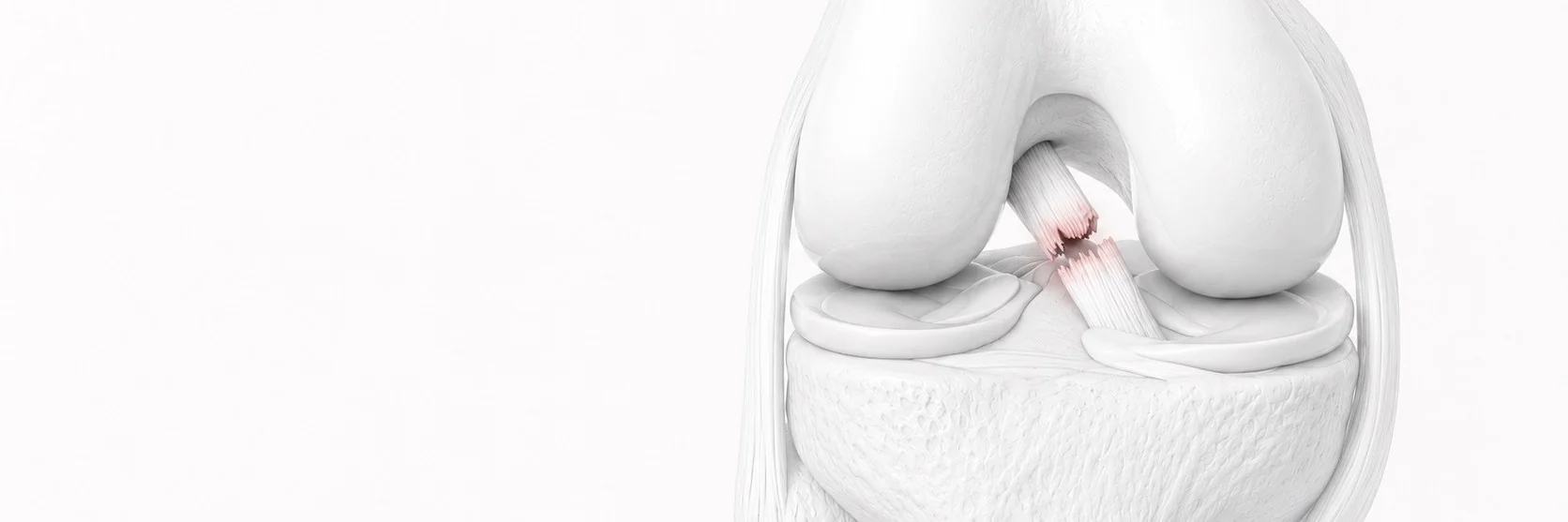
What is an ACL tear?
The anterior cruciate ligament (ACL) is one of the four main ligaments that stabilise the knee. It runs through the middle of the joint, from the back of the femur to the front of the tibia, and is the primary restraint against forward translation and rotation of the tibia.
An ACL tear is a partial or complete rupture of the anterior cruciate ligament (ACL), and it is one of the most common and serious sports injuries affecting the knee.
What causes an ACL tear?
ACL injuries typically occur during:
- sudden change of direction with the foot planted (cutting and pivoting sports)
- rapid deceleration
- landing awkwardly from a jump
- direct contact to the knee
They are common in football, basketball, skiing, handball, rugby and similar sports. Many ACL injuries are non-contact, the knee "gives way" with no opponent involved.
Who is at higher risk?
- young, active patients participating in cutting and pivoting sports
- female athletes, at 2–8 times higher risk than male counterparts
- patients with certain anatomical and biomechanical features (narrow notch, increased tibial slope, dynamic valgus on landing)
- patients with poor neuromuscular control or insufficient pre-conditioning
What are the symptoms?
- a distinct "pop" felt or heard at the moment of injury
- rapid swelling within hours due to bleeding inside the joint (haemarthrosis)
- severe pain at the time of injury
- inability to continue sport or activity
- later, a sense of giving way or instability with cutting and pivoting movements
- weakness and reduced confidence in the knee
What should you do if you suspect an ACL injury?
Initial first-aid measures (PRICE: Protection, Rest, Ice, Compression, Elevation) are appropriate. The most important step is a timely clinical assessment by a knee specialist, ideally within 1–2 weeks, so that the diagnosis is confirmed and a plan is made before the swelling and the muscles deteriorate.
How is the diagnosis made?
- clinical examination, including specific tests (Lachman, anterior drawer, pivot shift)
- X-rays, to exclude associated bony injuries
- MRI, the gold standard for confirming the diagnosis and identifying associated meniscus, cartilage and other ligament injuries
Associated injuries are common and have a major influence on treatment. Identifying them all is essential before deciding on the strategy.
Does every ACL tear require surgery?
Not every ACL tear requires surgery. The decision depends on the patient's age, activity level, symptoms of instability and any associated injuries:
- young, active patients with high sporting demands typically benefit from reconstruction
- less active or older patients without instability may do well with structured rehabilitation alone
- tears with significant associated meniscus or cartilage injury usually need surgical reconstruction to protect the joint long-term
- patients with persistent giving way despite rehabilitation are surgical candidates regardless of age
What is the conservative treatment?
Conservative treatment focuses on:
- swelling control and protection in the early phase
- structured physiotherapy with progressive strengthening and neuromuscular control
- Molecular & Biological Regenerative Therapy (PRP) in selected cases
- activity modification and use of a functional brace if appropriate
Where conservative care is chosen, regular review is essential to detect any deterioration and to reconsider surgery if needed.
When is surgery recommended?
Surgery is generally recommended when:
- the patient is young and active with sporting demands
- there is persistent instability after rehabilitation
- there are significant associated meniscus or cartilage injuries
- the patient's work or daily life requires a stable knee
How is ACL surgery performed?
ACL surgery is performed arthroscopically through small incisions. There are two main strategies:
The standard treatment for most ACL tears. The torn ligament is replaced with a graft, typically taken from the patient's own hamstring or quadriceps tendon. Bone tunnels are drilled in the femur and tibia, the graft is passed through anatomically, and it is secured under appropriate tension. Modern techniques aim for anatomic single- or double-bundle reconstruction with reliable graft fixation.
In selected cases, typically fresh proximal tears in young, active patients, primary repair of the ligament is possible with the Ligamys® dynamic intra-ligamentary stabilisation system. The torn ends of the patient's own ligament are reattached and protected during healing. This preserves the patient's native ACL and is a true joint-preserving option in the right indication.
What should the patient expect after surgery?
- the procedure is most often performed as a day case
- structured rehabilitation begins immediately, focused on swelling control and quadriceps activation
- the rehabilitation programme is progressive and goal-based, with milestones at 6 weeks, 3 months and 6 months
- return to running typically at 3–4 months
- return to non-contact sport at 6–9 months and to contact/pivoting sport at 9–12 months, with passing of return-to-sport testing
What is the recovery like?
ACL recovery is a marathon, not a sprint. Modern criteria-based rehabilitation has clearly shown that returning to sport too early dramatically increases the risk of re-injury.
For a stage-by-stage guide to what recovery feels like, what is normal along the way and when you can return to sport, read Recovery after ACL reconstruction: what to expect.