

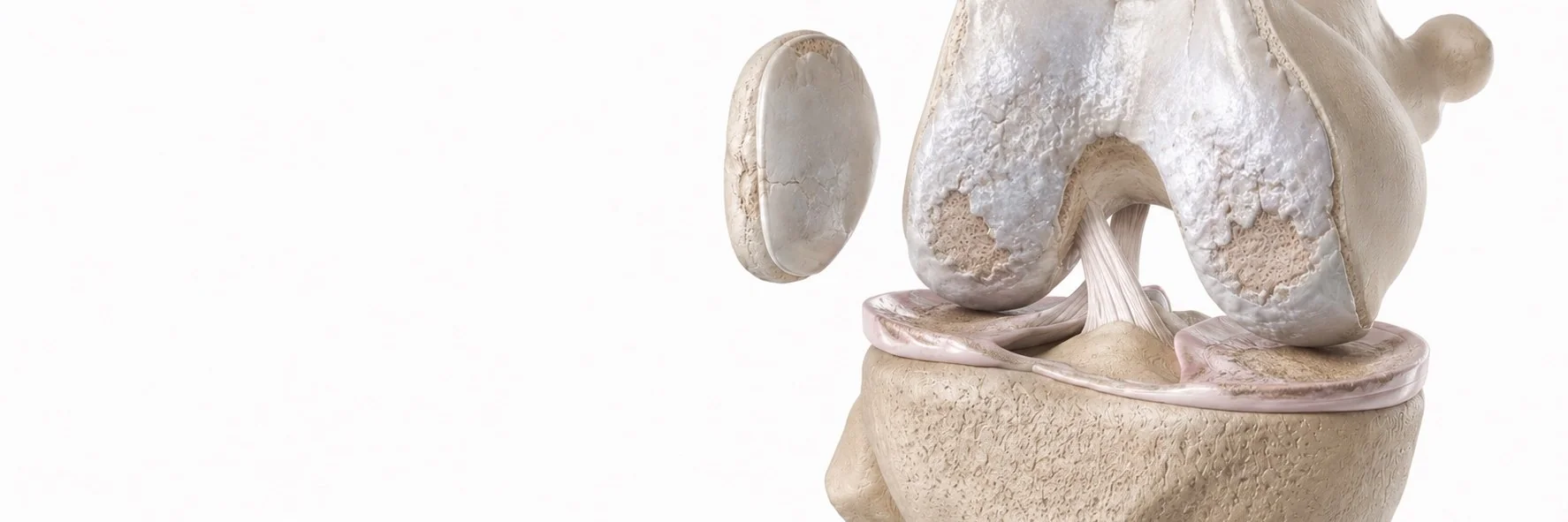
What is knee osteoarthritis?
Knee osteoarthritis is a progressive degenerative condition in which the articular cartilage that lines the joint surfaces gradually wears away. Cartilage is the smooth, low-friction tissue that allows the femur and tibia to glide against each other.
As cartilage thins and is lost, the underlying bone becomes exposed, leading to pain, stiffness, swelling and progressive loss of function. Knee osteoarthritis is one of the most common causes of chronic disability worldwide.
What causes it?
Knee osteoarthritis is multifactorial. The most important risk factors are:
- age, prevalence rises sharply after 50
- previous knee injury (meniscus tear, ACL injury, fracture)
- previous knee surgery, particularly meniscectomy
- malalignment of the leg (varus or valgus)
- overweight and obesity
- genetic predisposition and family history
- occupational and sports-related repetitive load
In many patients several factors combine. Identifying the dominant factor influences treatment, for example, malalignment may be correctable with osteotomy.
What are the symptoms?
- pain that worsens with activity and improves with rest
- morning stiffness, typically lasting under 30 minutes
- swelling, particularly after activity
- reduced range of motion, especially flexion
- crepitus, a grinding or crackling sensation with movement
- difficulty with stairs, kneeling and prolonged walking
- in advanced disease, deformity (bow-legged or knock-kneed) and rest pain
How is the diagnosis made?
- clinical examination, assessing range of motion, alignment, stability and tender points
- weight-bearing X-rays, the cornerstone of staging, showing joint space narrowing, osteophytes and bony changes
- long-leg standing radiographs to assess overall alignment when relevant
- MRI, used selectively to evaluate cartilage, meniscus and soft tissues, particularly in earlier disease or when planning joint-preserving surgery
Staging guides treatment. Early-stage disease has many options; advanced bone-on-bone disease typically requires replacement surgery for durable relief.
What is the conservative treatment?
For most patients, treatment begins with non-surgical measures:
- weight management, even modest weight loss reduces joint load substantially
- low-impact exercise, cycling, swimming, structured strengthening
- physiotherapy focused on quadriceps and gluteal strength, gait and biomechanics
- analgesics and anti-inflammatory medication when appropriate
- intra-articular injections, corticosteroids for flares, hyaluronic acid for selected patients
- Molecular & Biological Regenerative Therapy (PRP) for early to moderate disease
- unloader brace in selected unicompartmental cases
When is surgery considered?
Surgical treatment is considered when:
- pain interferes with daily life despite optimised conservative treatment
- sleep is disrupted by knee pain
- function is significantly limited (walking distance, stairs, work)
- X-rays confirm advanced cartilage loss
The choice of operation depends on the pattern and severity of disease, the patient's age and activity level, and any associated malalignment.
What are the surgical options?
For younger, active patients with single-compartment arthritis and malalignment. The bone is realigned to shift load away from the worn compartment. This delays or avoids replacement and preserves the natural joint.
When arthritis is confined to one compartment and the ligaments are intact. Only the worn compartment is resurfaced. This is less invasive than total replacement, with faster recovery and a more natural-feeling knee.
For advanced multi-compartmental arthritis. Modern implants and surgical techniques deliver reliable pain relief and durable function. Implant survivorship at 15–20 years is now excellent.
What should the patient expect after surgery?
- after osteotomy: protected weight-bearing for 6 weeks, return to most activities by 4–6 months
- after partial replacement: full weight-bearing within days, return to most activities by 6–12 weeks
- after total replacement: full weight-bearing within days, walking aids for 2–4 weeks, return to most activities by 3–6 months
- physiotherapy is essential in all cases, early, structured and progressive
- most patients drive again at 4–8 weeks, return to office work at 4–6 weeks, more demanding work at 3–4 months
What is the long-term outcome?
Outcomes after knee surgery for arthritis are reliable and well-documented. Patient satisfaction after total knee replacement exceeds 85% in modern series. Implant survivorship at 15–20 years is over 90% in most national registries.