

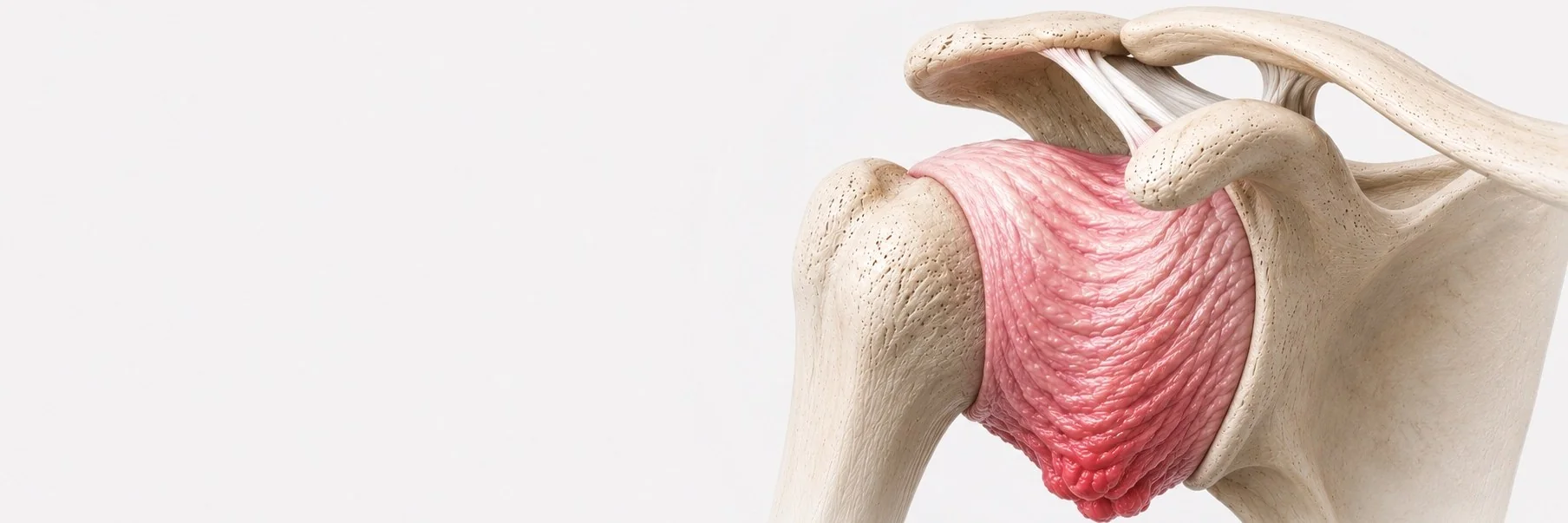
What is frozen shoulder?
Frozen shoulder, or adhesive capsulitis, is a condition in which the capsule surrounding the shoulder joint becomes inflamed, thickened and contracted, leading to progressive pain and stiffness.
It typically affects adults between 40 and 60 years of age and is more common in women. Although the natural course is one of eventual recovery, the course can extend to 1–3 years if untreated, with significant impact on daily life.
What causes it?
Frozen shoulder is divided into two forms:
- primary (idiopathic), develops without an identifiable cause, although it is more common in patients with diabetes, thyroid disease and other metabolic conditions
- secondary, develops after an injury, after shoulder or breast surgery, or in association with prolonged immobilisation
Diabetes is the strongest risk factor, patients with diabetes are 2–4 times more likely to develop frozen shoulder, and their course tends to be longer and more resistant to treatment.
What are the phases?
Frozen shoulder classically progresses through three overlapping phases:
- freezing phase, pain develops gradually, often worse at night, and motion begins to be lost (typically 2–9 months)
- frozen phase, pain may improve but stiffness dominates, with marked loss of both passive and active range of motion (typically 4–12 months)
- thawing phase, range of motion gradually returns over many months (typically 6–24 months)
Recognising the phase is essential because treatment differs, pain control dominates the early phase, while gentle stretching becomes more important as pain settles.
What are the symptoms?
- deep, often disabling shoulder pain, particularly at night
- progressive loss of motion in all directions, especially external rotation
- difficulty with everyday tasks such as dressing, reaching the back pocket or fastening a bra
- loss of motion that is present whether the patient or the examiner moves the arm, a key distinguishing feature
How is it diagnosed?
Diagnosis is largely clinical, based on the history and on the characteristic loss of both passive and active range of motion. Investigations are used selectively:
- X-rays, usually normal, used to rule out arthritis or other bony pathology
- MRI, confirms capsular thickening and excludes rotator cuff tears
- blood tests, sometimes useful when an underlying metabolic or inflammatory condition is suspected
What is the conservative treatment?
The majority of patients respond well to a structured non-operative programme. I always tell patients that frozen shoulder rewards patience, pushing too aggressively in the painful phase can prolong the disease.
- anti-inflammatory medication
- paced physiotherapy matched to the phase of disease, pain-led in the freezing phase, stretching-focused in the frozen phase
- intra-articular corticosteroid injection, particularly effective in the painful phase
- hydrodilatation, distending the capsule with saline to break adhesions and accelerate recovery
- optimisation of underlying conditions, particularly diabetes
When is surgery considered?
Surgical treatment is considered only when:
- symptoms persist beyond 6–12 months despite a thorough non-operative programme
- pain and stiffness are seriously impairing quality of life
- the patient has reached a plateau and is unwilling to continue waiting for natural resolution
Surgery, arthroscopic capsular release, is performed in only a small minority of cases. The contracted capsule is selectively divided arthroscopically, immediately restoring most of the lost motion.
How is arthroscopic capsular release performed?
I perform arthroscopic capsular release through small incisions, working inside the shoulder joint. Specific portions of the contracted capsule are divided in a controlled, anatomical pattern. Range of motion is then assessed and confirmed before closure.
What should the patient expect after surgery?
- the procedure is most often performed as a day case
- physiotherapy starts the same day or the day after, early motion is essential to prevent re-stiffening
- the first 6 weeks are intensive, daily home exercises and frequent physiotherapy
- most patients regain functional motion within 8–12 weeks
- final recovery typically takes 3–6 months
What is the long-term outcome?
The vast majority of patients, whether treated conservatively or surgically, recover excellent function. Recurrence in the same shoulder is uncommon, although the opposite shoulder can be affected in up to 20% of patients over time.