

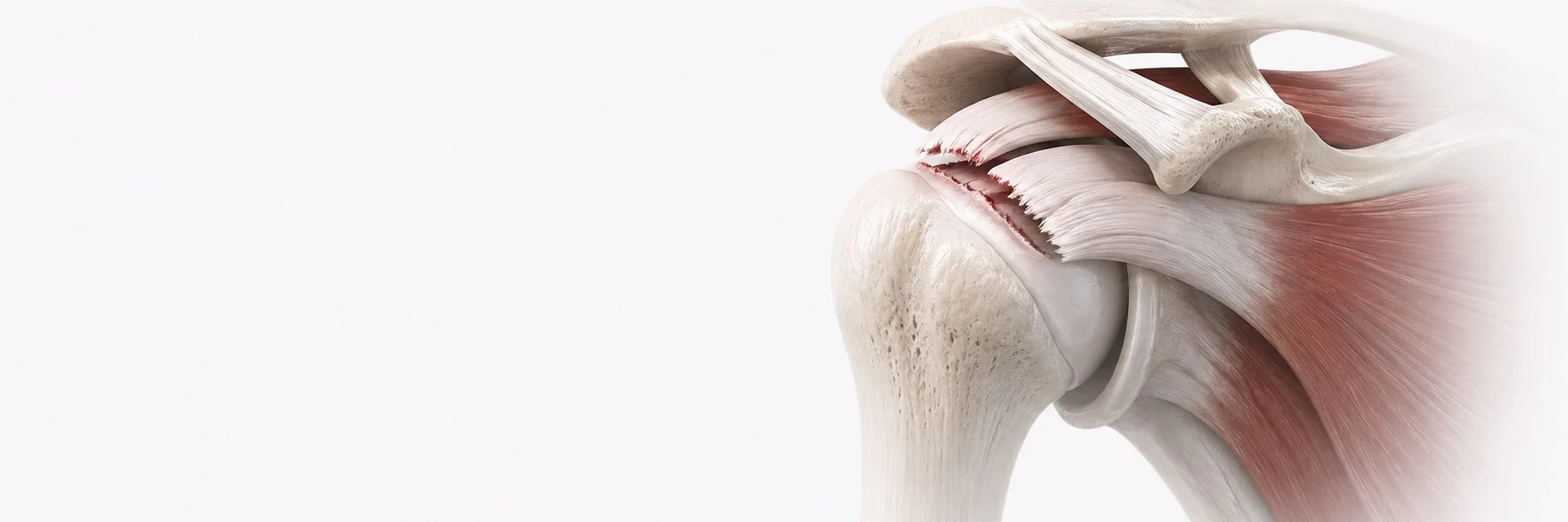
What is a rotator cuff tear?
The rotator cuff is a group of four tendons, supraspinatus, infraspinatus, teres minor and subscapularis, that surround the shoulder joint. They lift, rotate and stabilise the shoulder during movement.
A rotator cuff tear occurs when one or more of these tendons becomes partially or completely torn, disrupting the strength and balance of the shoulder.
What causes a rotator cuff tear?
Tears occur for two main reasons:
- trauma, a fall on the outstretched arm, lifting a heavy object, or a direct injury
- chronic tendon degeneration, the much more common scenario, where the tendon becomes progressively weaker with age and eventually tears, often without significant trauma
Tendon tears become more common with age. They are relatively rare under 50 but a significant proportion of patients over 60 have some degree of tear, often without major symptoms.
What are the symptoms?
Shortly after a tear occurs, patients may experience:
- shoulder pain
- weakness and difficulty moving the arm
After the acute phase, the symptoms typically include:
- pain when lifting the arm or reaching overhead
- pain at night, particularly when lying on the affected side
- weakness during daily activities
- limited range of motion
The exact pattern depends on which tendon is involved and on whether the tear is partial or complete.
What types of tears exist?
- Partial tear, the tendon is damaged but not completely disrupted
- Complete tear, the tendon is fully torn or detached from the bone
Tears are further classified by size (small, medium, large, massive) and by the quality of the tendon and surrounding muscle, both of which significantly affect treatment planning and outcome.
How is a rotator cuff tear diagnosed?
Diagnosis is based on:
- clinical examination, including specific tests for each tendon
- assessment of strength and range of motion
- X-rays, to assess bone anatomy and exclude arthritis
- ultrasound, for dynamic assessment of the tendons
- MRI, the gold standard for evaluating tear size, tendon quality and muscle condition
Treatment planning depends on patient age, functional demands, the size of the tear and the quality of the tendon and muscle.
What is the conservative treatment?
If functional movement is preserved, strength is acceptable and pain is manageable, conservative treatment is often successful, particularly for partial tears or in older patients with lower functional demands. It includes:
- rest and temporary use of a sling
- anti-inflammatory and pain medication
- subacromial corticosteroid injection in selected cases
- Molecular & Biological Regenerative Therapy (PRP) where appropriate
- physiotherapy focused on the rotator cuff and scapular stabilisers
After an initial period of protection, a structured rehabilitation programme begins, usually after a few weeks of relative rest.
When is surgery required?
Surgical treatment is usually recommended in:
- younger, active patients with high functional demands
- larger or complete tears
- tears with persistent pain or weakness despite conservative treatment
- acute traumatic tears in patients who would benefit from early repair
How is rotator cuff repair performed?
I perform arthroscopic rotator cuff repair through small incisions. During the procedure I:
- identify and prepare the torn tendon
- anchor the tendon back to its bony insertion using suture anchors
- address any associated pathology, biceps, labrum, acromial impingement
What should the patient expect after surgery?
- a shoulder sling is worn for approximately 4–6 weeks to protect the repair
- passive physiotherapy starts within the first days
- active and resisted exercises are introduced gradually from around 6 weeks
- return to manual work and sport typically takes 4–6 months, depending on tear size
What is the long-term outcome?
Most patients regain a strong, well-functioning shoulder. The long-term result depends on tear size, tendon and muscle quality at the time of surgery, the technical quality of the repair and adherence to rehabilitation.