

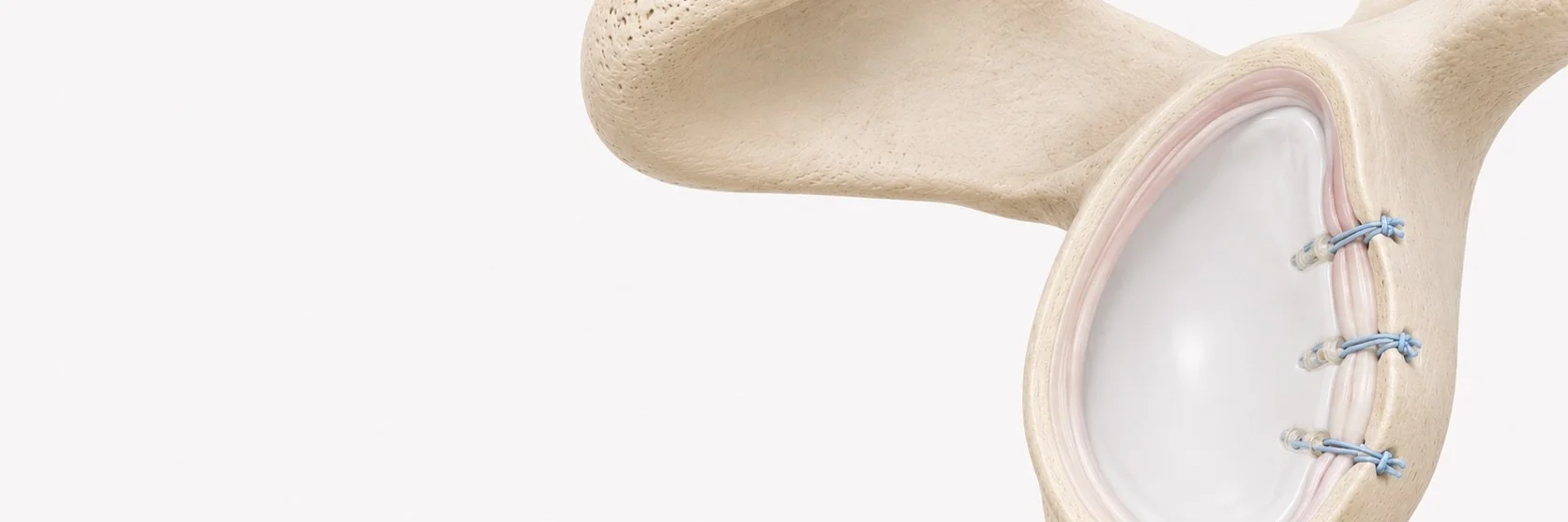
What is shoulder stabilisation surgery?
Shoulder stabilisation is a surgical procedure to restore stability to a shoulder that repeatedly dislocates or feels unstable. The most common cause is a tear of the labrum (the fibrocartilaginous rim around the socket) and the capsule, typically after a traumatic dislocation.
Modern stabilisation surgery is performed arthroscopically through small incisions in the majority of cases.
When is stabilisation needed?
Surgical stabilisation is recommended for:
- recurrent dislocations or subluxations
- first-time dislocations in young and active patients (especially under 25, in contact sports)
- apprehension or a persistent sense of instability that limits activity
- demonstrable labral tear or bone loss on imaging
Arthroscopic Bankart Repair
For typical recurrent instability without significant bone loss, I perform arthroscopic Bankart repair. The torn labrum is reattached to the rim of the glenoid using suture anchors and high-strength sutures, small implants that fix the soft tissue back to bone with strong sutures.
The procedure is performed through 3–4 small portals around the shoulder, with magnified visualisation of the joint. Most procedures are performed as day-case surgery.
What should the patient expect after surgery?
- arthroscopic Bankart repair is typically a day case
- a sling is worn for 4–6 weeks to protect the repair
- physiotherapy starts within the first week, focused on protected range of motion
- progressive strengthening from 6 weeks
- return to non-contact sport at 4–5 months
- return to contact sport at 6–9 months
What is the long-term outcome?
Modern shoulder stabilisation surgery has well-documented outcomes:
- arthroscopic Bankart repair: re-dislocation rate 5–15% in well-selected patients
- most patients successfully return to their previous activities, including contact sport