

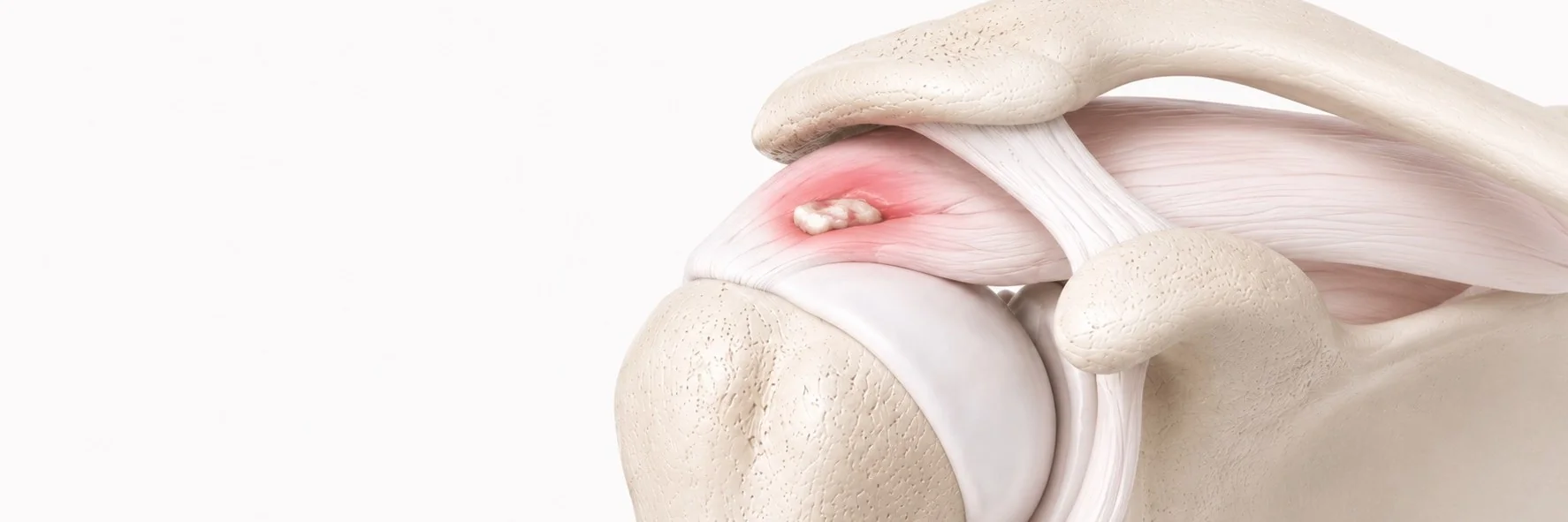
What is calcific tendonitis of the shoulder?
Calcific tendonitis is a condition in which calcium deposits form within the tendons of the rotator cuff, most commonly in the supraspinatus and infraspinatus. The deposits develop as a result of degenerative changes in the tendon tissue and, over time, lead to swelling of the tendon, increased pressure within the tissue and chemical irritation of the surrounding structures.
Repeated inflammation in the same area can eventually lead to local tissue damage. Because the tendon has limited blood supply, it becomes more prone to calcium deposition.
What are the stages of calcific tendonitis?
The condition typically progresses through three stages:
Formative phase, calcium deposits begin to form within the tendon. This is often a relatively quiet phase with mild or even absent symptoms.
Resorptive phase, usually the most painful stage. The calcium begins to dissolve and may leak into the subacromial space, triggering intense inflammation. Pain can be severe, especially with movement or at night, and in some cases the patient is temporarily unable to move the arm.
Postcalcific phase, the deposit resolves and the tendon gradually heals.
What are the symptoms?
Symptoms depend on the stage but commonly include:
- shoulder pain, especially during overhead movements
- night pain when lying on the affected side
- sudden episodes of severe pain
- limited movement due to pain
How is it diagnosed?
Diagnosis is straightforward and combines clinical examination with imaging:
- X-rays, usually show the calcium deposit clearly
- ultrasound, useful both for diagnosis and for ultrasound-guided treatment
- MRI, when associated rotator cuff or other shoulder pathology needs to be ruled out
What is the conservative treatment?
In the acute stage, treatment is usually conservative and includes:
- non-steroidal anti-inflammatory medication
- local anaesthetic measures
- subacromial corticosteroid injections
- Molecular & Biological Regenerative Therapy (PRP) where appropriate
- physiotherapy
The aim is to control inflammation and relieve pain while the condition progresses through its natural cycle. I make a point of explaining that early treatment can improve symptom control and shorten the painful phase.
When is surgery considered?
If symptoms persist or do not respond to conservative treatment, arthroscopic treatment may be considered.
How is arthroscopic treatment performed?
Arthroscopic treatment is performed through very small (millimetre-sized) incisions. A camera is introduced into the joint to allow direct visualisation, and specialised instruments are used through additional small openings. During the procedure I perform:
- removal of the calcium deposits
- cleaning of the affected tendon
- treatment of associated pathology within the shoulder
I apply modern arthroscopic techniques aiming for stable repair, minimal tissue damage and the fastest possible recovery.
What should the patient expect after surgery?
The outcome is typically excellent, with rapid relief of symptoms:
- appropriate pain medication is given after the procedure
- the hospital stay is usually short, often a single day
- a structured physiotherapy programme follows, focused on quick reduction of pain and restoration of full shoulder function