

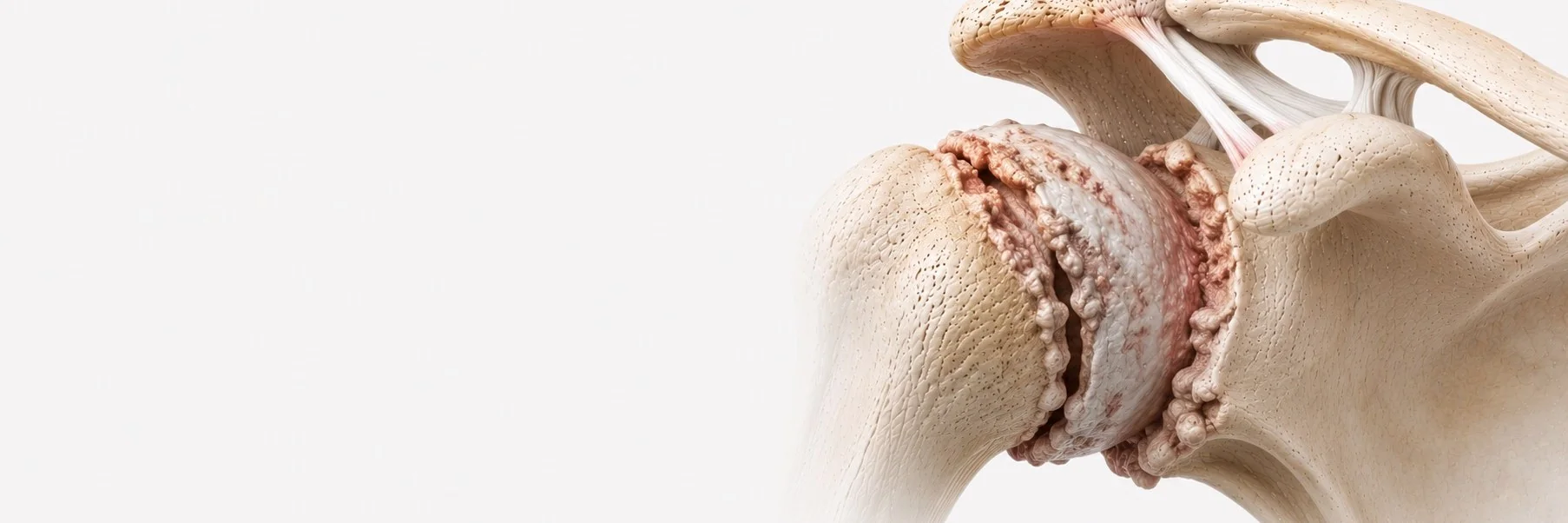
What is shoulder osteoarthritis?
The shoulder is a ball-and-socket joint formed by the head of the humerus and the glenoid of the scapula. Smooth cartilage covers both surfaces and allows the wide, painless range of motion the shoulder is built for.
Shoulder osteoarthritis is a condition in which this cartilage gradually wears down. As it deteriorates, the joint becomes painful, stiffer and progressively less functional in everyday life.
What causes shoulder osteoarthritis?
Shoulder osteoarthritis can develop slowly over time as part of natural ageing, or as a consequence of an underlying cause:
- previous injury (fracture or shoulder dislocation)
- chronic rotator cuff disease
- repetitive overload through work or sport
- inflammatory joint disease (rheumatoid arthritis and others)
In many patients, no single trigger can be identified, the condition develops quietly over years.
What are the symptoms?
- persistent or activity-related pain in the shoulder
- stiffness and a reduction in range of motion
- difficulty with daily tasks (lifting, reaching overhead, dressing)
- mechanical clicking or grinding during movement
Symptoms typically progress over time as the cartilage damage advances.
How is it diagnosed?
Diagnosis is based on:
- clinical history and examination
- assessment of joint movement and strength
- X-rays of the shoulder, which show joint space narrowing, osteophytes and subchondral changes
- MRI when a more detailed evaluation of cartilage and rotator cuff is needed
The key thing is that early diagnosis matters, outcomes are significantly better when the condition is identified before extensive cartilage loss.
What is the conservative treatment?
Conservative management aims to control pain and preserve function for as long as possible:
- non-steroidal anti-inflammatory medication
- intra-articular injections (cortisone or hyaluronic acid)
- Molecular & Biological Regenerative Therapy (PRP) under image guidance
- physiotherapy and progressive strengthening of the rotator cuff and scapular stabilisers
- activity modification and load management
Applied early, this approach can meaningfully reduce symptoms and slow progression. It cannot, however, reverse cartilage that has already been lost, which is why timing matters.
What are the joint-preserving surgical options?
When conservative care no longer controls symptoms but the joint is not yet completely destroyed, joint-preserving arthroscopic surgery may be appropriate. Through small incisions I can:
- debride unstable cartilage fragments
- remove loose bodies that lock or catch
- address concomitant rotator cuff or biceps pathology
- improve the mechanical environment of the joint
This approach is sometimes called Comprehensive Arthroscopic Management (CAM). For localised cartilage defects, I can also apply modern restoration techniques, including the Minced Cartilage technique, drawing on my training at one of the largest cartilage centres in Europe.
When is shoulder replacement needed?
In advanced osteoarthritis with widespread cartilage loss, where pain dominates daily life and joint-preserving options have been exhausted, anatomic or reverse shoulder replacement provides reliable pain relief and restores function. The choice between the two depends on the state of the rotator cuff and the pattern of joint wear, and is discussed in detail on the Shoulder Replacement page.