

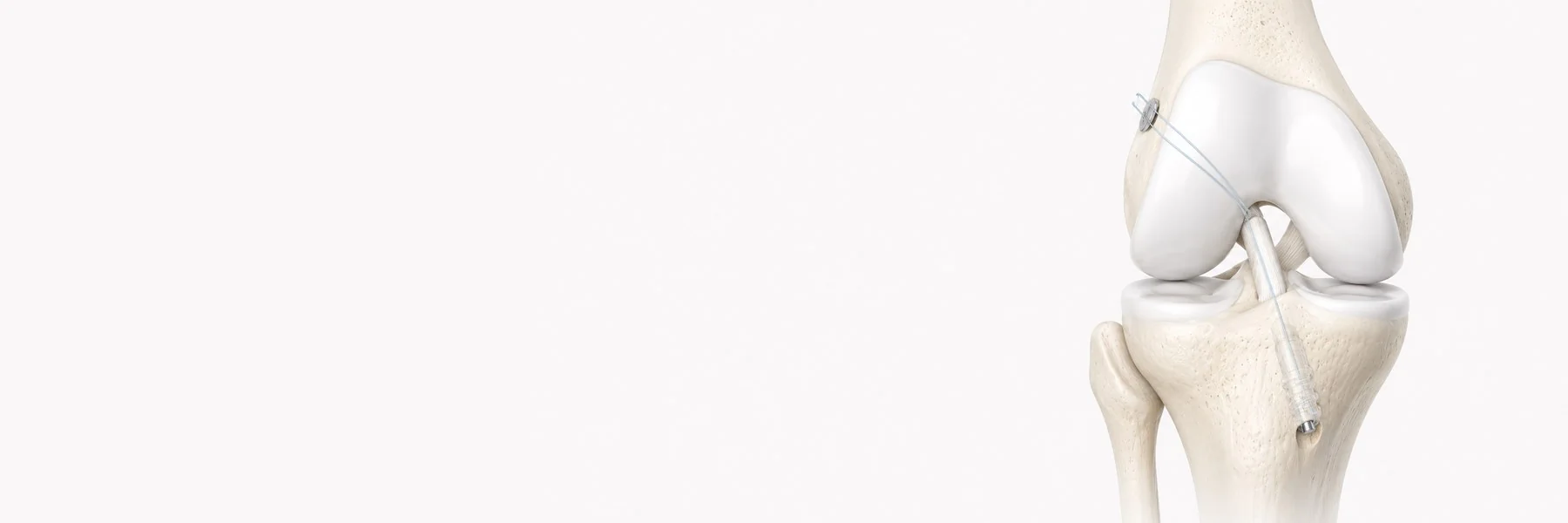
What is ACL reconstruction?
ACL reconstruction is the standard surgical treatment for a torn anterior cruciate ligament. The torn ligament cannot be sewn back together reliably in most cases, instead, a new ligament is reconstructed using the patient's own tendon (autograft), positioned anatomically within bone tunnels in the femur and the tibia.
It is one of the most studied operations in orthopaedic surgery, with decades of refinement and excellent long-term published outcomes.
When is ACL reconstruction needed?
Reconstruction is recommended for:
- younger, active patients who want to return to cutting and pivoting sports
- patients with episodes of knee instability or “giving way”
- patients with associated meniscus tears that need repair
- patients whose work or lifestyle requires a stable knee
What graft is used?
I use the patient's own tendon (autograft) for the new ACL, choosing between options based on the patient's profile:
- hamstring autograft, most commonly used; minimal donor-site morbidity, excellent strength, well-tolerated
- quadriceps tendon autograft, increasingly popular for athletic patients; thicker graft, smaller incision, lower kneeling pain than patellar tendon
- patellar tendon autograft (BTB), once the gold standard, less commonly chosen today; still preferred in selected high-level athletes involved in pivoting sports
Graft choice is not predetermined. It follows from each patient's characteristics and needs, sport, activity level, body type and surgical history. The aim is to find the option best suited to the individual.
How is the operation performed?
I perform ACL reconstruction arthroscopically through small incisions:
- the selected autograft is harvested through a separate small incision
- any associated meniscus or cartilage injury is addressed first
- precise tunnels are drilled in the femur and tibia at the anatomical attachment sites of the original ACL
- the new graft is passed through the tunnels and fixed at both ends with modern, reliable fixation devices
- the knee is taken through a full range of motion to confirm stability and tracking
What should the patient expect after surgery?
- the procedure is most often performed as a day case
- crutches are used for 1–2 weeks with full weight-bearing as tolerated
- a knee brace is worn for the first 4–6 weeks in some cases
- physiotherapy starts immediately, focused on swelling control and quadriceps activation
- driving usually resumes after 4–6 weeks (particularly after right knee surgery)
How long is the rehabilitation?
ACL rehabilitation is a marathon, not a sprint. The graft heals over many months, and modern criteria-based rehabilitation programmes have clearly shown that returning to sport too early significantly increases the risk of re-injury.
- weeks 0–6: range of motion, swelling control, gait training
- weeks 6–12: progressive strengthening and proprioception
- months 3–6: running and sport-specific drills
- months 6–9: return to non-contact sport after successfully passing return-to-sport testing
- months 9–12: return to contact and pivoting sport
What each stage involves, which symptoms are normal and which are not, and why return-to-sport tests matter more than the date are explained in Recovery after ACL reconstruction: what to expect.
What is the long-term outcome?
ACL reconstruction has well-documented outcomes:
- over 90% of patients regain a stable knee
- 70–85% of athletes return to their previous level of sport
- graft retear rates are 5–15% depending on age and activity
- long-term arthritis risk is reduced compared to leaving an ACL-deficient knee unreconstructed in active patients