

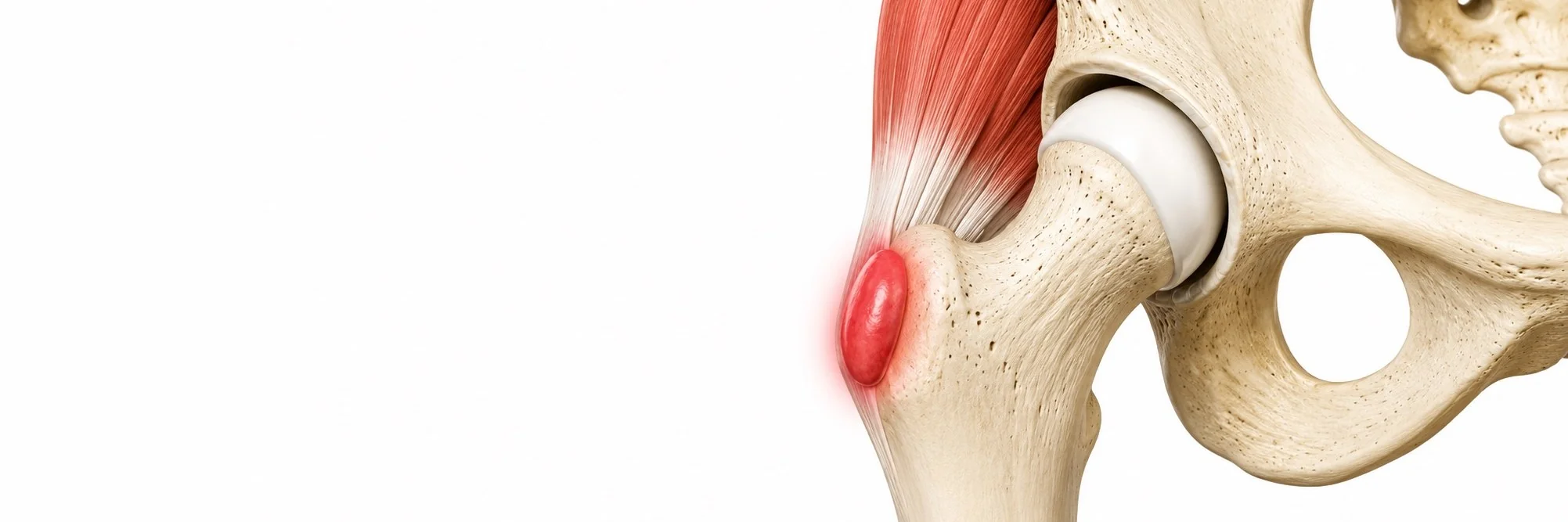
What is trochanteric bursitis?
Trochanteric bursitis is the inflammation of the bursa overlying the greater trochanter, the prominent bone on the outer side of the hip. The modern term Greater Trochanteric Pain Syndrome (GTPS) is more accurate, because the condition usually involves not just the bursa but also the gluteus medius and minimus tendons that attach to the trochanter.
GTPS is one of the most common causes of side-of-hip pain, particularly in middle-aged and older women.
What causes it?
- repetitive friction from walking, running or climbing stairs
- tendinopathy of the gluteus medius and minimus
- lumbar spine and pelvic mechanics that overload the lateral hip
- leg length discrepancy
- previous hip surgery
- direct trauma, a fall onto the side of the hip
- weak gluteal muscles
What are the symptoms?
- pain on the outer side of the hip
- pain that worsens when lying on the affected side, often disturbing sleep
- pain on prolonged standing, walking and climbing stairs
- tenderness directly over the greater trochanter on examination
- pain that may radiate down the outer thigh
How is the diagnosis made?
- clinical examination, the diagnosis is largely clinical
- ultrasound, useful for assessing tendon and bursa pathology and for guided injection
- MRI, when more detailed assessment is needed, particularly to evaluate gluteal tendon tears
- X-rays in selected cases to exclude other hip pathology
What is the conservative treatment?
The vast majority of cases respond well to conservative treatment:
- activity modification and load management
- anti-inflammatory medication
- ultrasound-guided corticosteroid injection in selected cases
- Molecular & Biological Regenerative Therapy (PRP) for chronic gluteal tendinopathy
- structured physiotherapy with progressive gluteal strengthening, this is the cornerstone of treatment
- addressing biomechanical factors (footwear, gait, leg length)
One point I keep coming back to is that early treatment can improve symptom control. With a properly conducted programme, most patients improve significantly within 2–3 months.
When is surgery required?
Surgery is rarely needed and is reserved for the small minority of patients with persistent symptoms despite extensive conservative treatment, or with significant gluteal tendon tears.
How is surgery performed?
When surgery is needed I perform endoscopic or open procedures depending on the pathology, typically bursectomy combined with gluteal tendon repair where indicated. I apply modern techniques aiming for stable repair and optimal functional recovery.
What should the patient expect after treatment?
- non-operative management gives excellent results in the majority of patients
- after surgery, a structured rehabilitation programme is followed for 3–6 months
- return to full activity is typically achieved at 4–6 months after gluteal tendon repair