

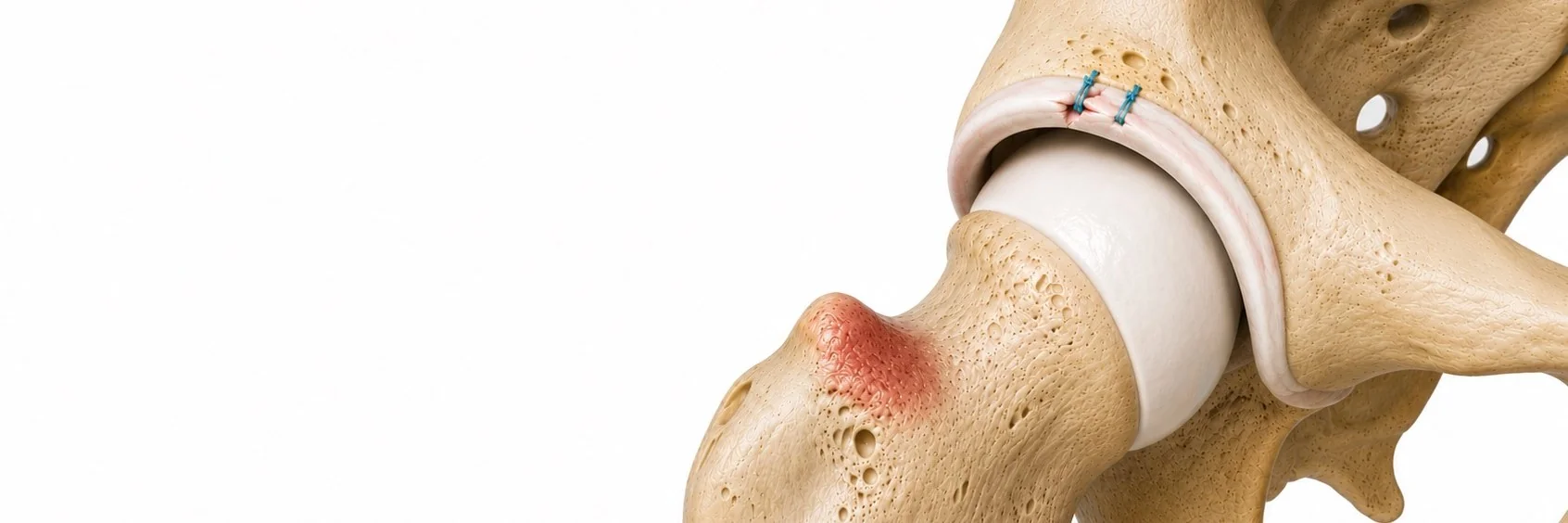
What is hip arthroscopy?
Hip arthroscopy is a minimally invasive surgical technique that allows me to operate inside the hip joint through small incisions, using a specialised camera and instruments. It has transformed the management of hip pain in young and middle-aged patients over the last two decades.
It is the joint-preserving alternative to hip replacement, addressing the underlying mechanical problem, repairing soft tissue damage and protecting the joint long-term.
When is hip arthroscopy needed?
The most common indications are:
- femoroacetabular impingement (FAI), the leading indication, particularly in younger active patients
- labral tears with mechanical symptoms (clicking, catching, deep groin pain)
- cartilage damage, debridement or cartilage restoration for local defects
- loose bodies, fragments of bone or cartilage causing locking
- iliopsoas impingement, snapping hip syndromes in selected cases
- synovitis or inflammatory conditions requiring biopsy or debridement
How is the operation performed?
The operation is performed under general anaesthesia with the patient on a specialised traction table that opens the hip joint. Two or three small portals (incisions of about 1 cm) provide access to the central and peripheral compartments of the joint.
A typical procedure includes:
- reshaping any cam bone abnormality on the femoral head/neck (femoroplasty)
- trimming any pincer over-coverage on the acetabular rim (acetabuloplasty)
- repairing the torn labrum with suture anchors, or reconstructing it when irreparable
- addressing any cartilage damage
- closing the capsule when appropriate to preserve hip stability
What should the patient expect after surgery?
- most procedures are performed as a day case
- crutches are used for 4–6 weeks, with partial weight-bearing initially
- physiotherapy starts within the first week, focused on protecting the repair while restoring motion
- driving usually resumes at 4–6 weeks
- return to office work at 2–4 weeks; physical work at 8–12 weeks
- return to running typically at 3–4 months
- return to full sport at 4–6 months
How important is rehabilitation?
Rehabilitation after hip arthroscopy is structured and progressive. The first 6 weeks focus on protecting the labral repair while regaining motion. The following months emphasise strengthening, biomechanics and gradual return to activity.
What is the long-term outcome?
Outcomes are generally very good in well-selected patients:
- 80–90% satisfaction at 2–5 years in modern series
- most patients return to their previous activities including sport
- addressing FAI early appears to slow the progression to arthritis
In patients with significant pre-existing arthritis, results are less reliable, and the right answer may be to plan for hip replacement instead.