

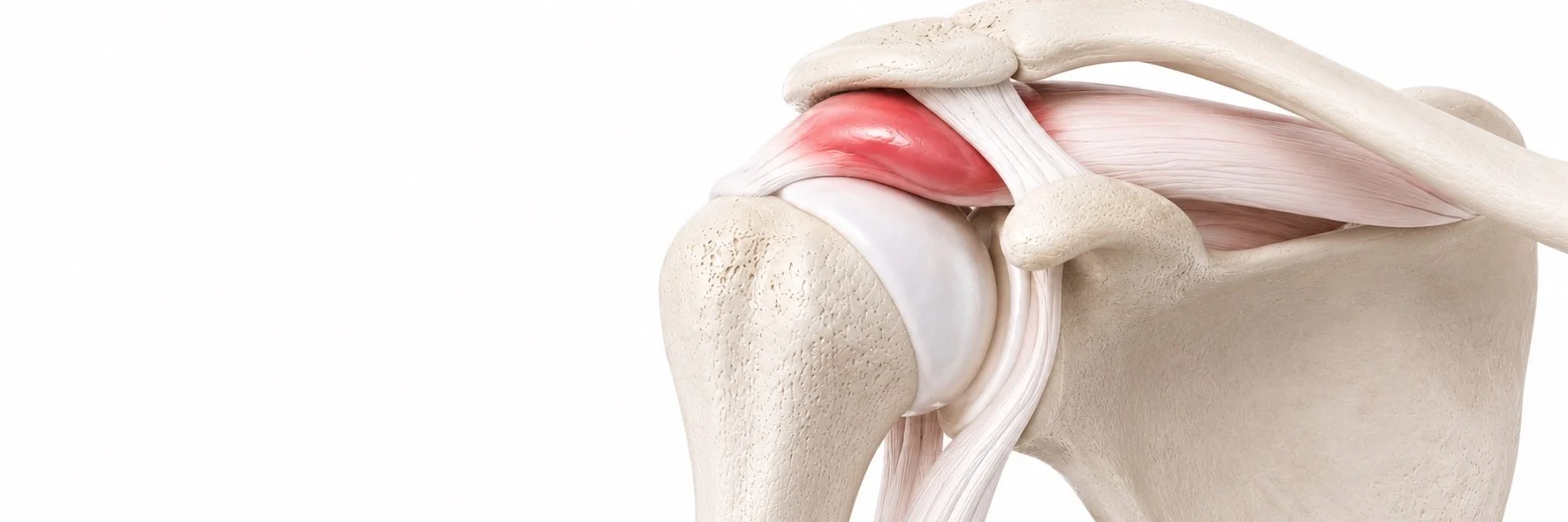
What is shoulder impingement syndrome?
Shoulder impingement syndrome is a condition in which the rotator cuff tendons are repeatedly compressed in the narrow space between the head of the humerus and the under-surface of the acromion. The repeated friction causes inflammation, pain and, over time, structural damage to the tendons themselves.
It is one of the most common causes of shoulder pain in adults of working and sporting age.
What are the causes?
Impingement is rarely the result of a single factor. It is usually a combination of:
- the shape of the acromion (a hooked or sloped acromion narrows the subacromial space)
- weakness or imbalance of the rotator cuff and scapular muscles
- repetitive overhead activity at work or in sport (swimming, throwing, painting, weightlifting)
- age-related tendon degeneration
- previous shoulder injury or postural abnormalities
What are the symptoms?
- shoulder pain when lifting the arm, particularly between 60° and 120° of elevation (the painful arc)
- pain at night when lying on the affected side
- weakness with overhead activities
- pain referred to the side of the upper arm
- occasionally clicking or catching
If left untreated, persistent impingement can progress to a partial or complete rotator cuff tear.
How is it diagnosed?
Diagnosis is based on clinical examination and imaging:
- specific provocation tests (Neer, Hawkins, painful arc)
- X-rays, to assess the shape of the acromion and rule out arthritis
- ultrasound, useful for dynamic assessment of the rotator cuff
- MRI, to evaluate the rotator cuff in detail and exclude tendon tears
What is the conservative treatment?
The majority of patients respond well to conservative care, especially when treatment is started early. I always tell patients that early treatment improves symptom control and prevents progression to a tendon tear. The plan typically includes:
- activity modification and avoidance of provocative overhead movements
- non-steroidal anti-inflammatory medication
- subacromial corticosteroid injection in selected cases
- Molecular & Biological Regenerative Therapy (PRP) where appropriate
- a structured physiotherapy programme focused on rotator cuff and scapular stabilisers
When is surgery considered?
Surgical treatment is considered when symptoms persist despite a well-conducted conservative programme, when there is significant mechanical impingement, or when there is associated rotator cuff pathology that needs treatment.
How is surgery performed?
I perform arthroscopic subacromial decompression through small incisions. During the procedure I:
- remove the inflamed bursa
- reshape the under-surface of the acromion (acromioplasty) where appropriate
- address any associated rotator cuff or biceps pathology
I apply modern arthroscopic techniques aiming for stable repair, minimal tissue damage and the fastest possible return to function.
What should the patient expect after surgery?
- the procedure is performed as a day case in most cases
- a sling is used for comfort, usually for a few days
- early gentle range of motion is started immediately
- a structured physiotherapy programme follows, with most patients returning to normal activity within 6–12 weeks