

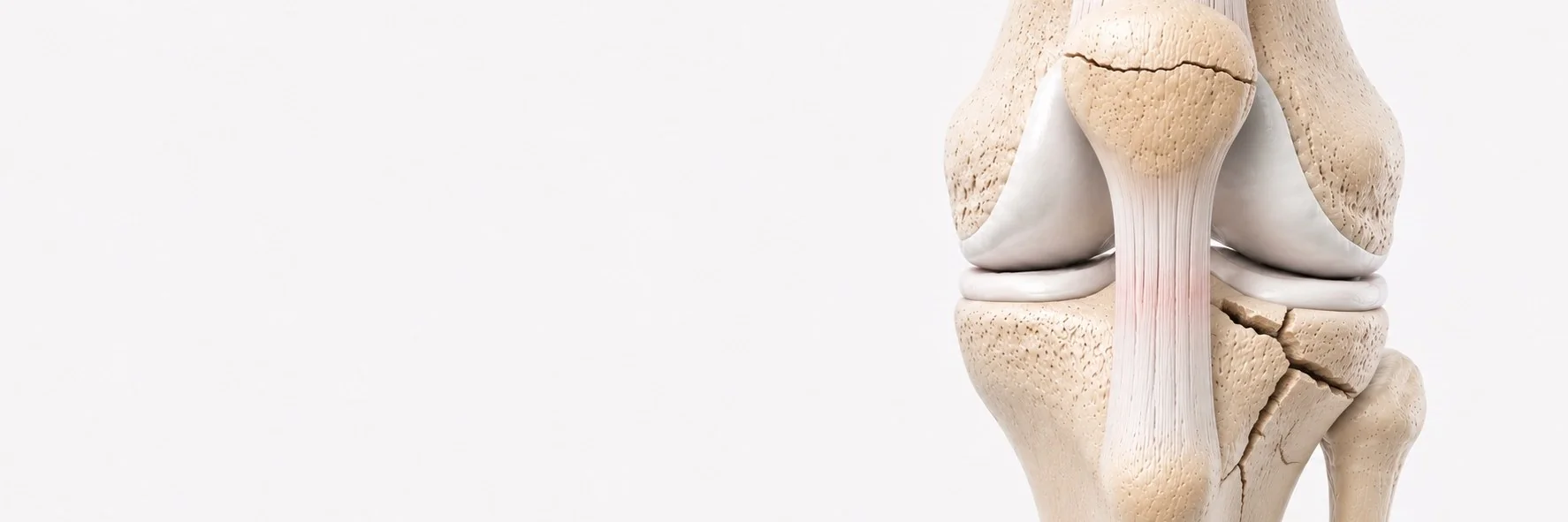
What are knee fractures?
Knee fractures are serious injuries that involve the bones forming the knee joint, the distal femur, the patella and most commonly the proximal tibia (tibial plateau). They are usually the result of significant trauma, falls from height, road traffic accidents, sporting injuries, and can range from simple, minimally displaced cracks to complex, comminuted fractures with significant joint surface damage.
These fractures need careful, structured management because the knee joint surface is unforgiving: any residual step in the cartilage surface translates directly into long-term arthritis. My goal is always to restore the joint surface as accurately as possible while minimising soft tissue damage.
What are the symptoms?
- severe pain immediately after the injury
- marked swelling around the knee
- inability to bear weight
- deformity in displaced fractures
- bruising spreading down the leg over the following days
- in some cases, neurovascular signs that need urgent assessment
How is the diagnosis made?
- thorough clinical examination, including assessment of the soft tissues, pulses and neurological status
- X-rays of the knee in multiple views, usually diagnostic for fracture pattern
- CT scan with three-dimensional reconstruction, essential for tibial plateau and complex fractures, allowing detailed pre-operative planning
- MRI in selected cases when associated meniscus or ligament injury is suspected
How are knee fractures classified?
The most common knee fractures are tibial plateau fractures, classified by Schatzker into six types based on the pattern and degree of joint surface depression. Other knee fractures include:
- distal femur fractures (supracondylar, intercondylar)
- patellar fractures (transverse, comminuted, vertical)
- tibial spine avulsions, particularly in younger patients
The classification directly informs treatment: a minimally displaced fracture may need only protected mobilisation, while a complex tibial plateau fracture may require advanced reconstruction.
What is the treatment?
Treatment depends on the fracture type, displacement, joint surface involvement and patient factors.
Conservative treatment
Minimally displaced fractures can sometimes be managed without surgery:
- knee brace and protected weight-bearing for 6–8 weeks
- early gentle range of motion to avoid stiffness
- structured progressive physiotherapy
- regular X-ray review to confirm healing without displacement
Surgical treatment
Most displaced knee fractures and all fractures with significant joint surface involvement require surgery. The principles are:
- anatomical restoration of the joint surface
- stable fixation that allows early controlled mobilisation
- minimal additional soft tissue trauma
- treatment of any associated meniscus or ligament injury
Advanced proximal tibia (plateau) fracture reconstruction
Tibial plateau fractures are an area where modern technique makes a real difference. I use:
- modern locking-plate systems shaped for the tibial plateau
- minimally invasive plate osteosynthesis (MIPO) techniques where appropriate
- arthroscopically-assisted reduction in selected cases, allowing direct visualisation of the joint surface
- bone grafting or bone substitutes to support the elevated joint surface
- patient-specific 3D planning in complex cases
I apply modern surgical techniques aiming for stable fixation, accurate joint surface reconstruction and the fastest possible functional recovery.
What is the goal of surgery?
The single most important goal is to restore the smooth congruency of the joint surface. Even small step-offs in the articular surface are tolerated poorly by knee cartilage and lead to early post-traumatic arthritis. The second goal is stable fixation that permits early movement, because a stiff knee after a fracture is almost as much of a problem as the fracture itself.
What happens after surgery?
- hospital stay typically 2–5 days depending on the fracture and patient factors
- knee brace for 6 weeks
- protected weight-bearing for 8–12 weeks for tibial plateau fractures, sometimes longer for complex patterns
- early gentle range of motion under physiotherapy guidance from the first post-operative week
- progressive strengthening once the fracture is healing
- return to running typically at 4–6 months and to sport at 6–12 months, depending on the injury
It is worth being clear that early mobilisation, balanced against fracture protection, is critical. Stiffness after a knee fracture is one of the most preventable poor outcomes, and avoiding it depends on starting the right rehabilitation at the right time.