

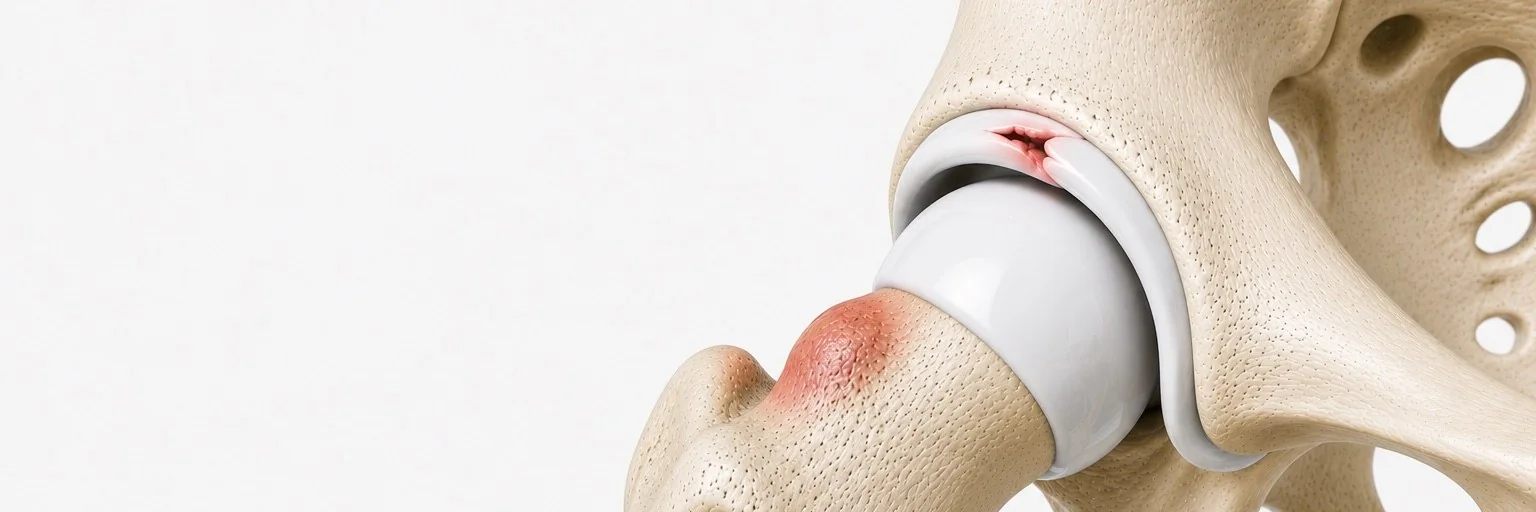
What is hip impingement and a labral tear?
Femoroacetabular impingement (FAI) is a condition in which the bones of the hip joint do not fit together perfectly. The result is abnormal, repeated contact between the head and neck of the femur and the rim of the acetabulum during normal movement, particularly during hip flexion and rotational movement.
Over time, this contact damages the labrum (a fibrocartilaginous rim around the socket that contributes to stability and a fluid seal) and the surrounding articular cartilage. FAI is one of the leading causes of hip pain in young adults and an important cause of early hip arthritis.
A labral tear is the most common consequence of FAI, but can also occur independently following trauma, dysplasia, or capsular laxity.
What types of FAI exist?
FAI is usually classified into three types based on the underlying bony shape:
- cam type, extra bone on the femoral head/neck junction, more common in young men
- pincer type, over-coverage of the femoral head by the acetabular rim, more common in middle-aged women
- mixed type, combination of cam and pincer (the most common pattern)
These bony abnormalities usually develop during adolescence as the skeleton matures and become symptomatic during periods of increased sporting and physical activity.
What are the symptoms?
- groin pain, often described with the "C-sign" (the patient cups the side and front of the hip with the hand)
- pain with deep flexion (squatting, sitting in low chairs, getting out of a car)
- pain during sporting activity, especially activities involving rotation, change of direction or kicking
- occasional clicking, catching, or locking sensations from labral tears
- in long-standing cases, secondary stiffness and radiographic signs of cartilage damage
Patients are often young, active, and have been told their hip pain is "just a strain", only to later realise that the symptoms persist and gradually worsen.
How are FAI and labral tears diagnosed?
- clinical examination, including specific impingement tests (FADIR, FABER)
- X-rays, assess the bony shape and any early signs of joint damage
- MRI or MR arthrogram, the preferred imaging modality for evaluating the labrum and articular cartilage
- in selected cases, CT for detailed three-dimensional bony assessment and surgical planning
- an ultrasound-guided diagnostic injection can help confirm that the pain originates from within the hip joint
What is the conservative treatment?
Conservative care is the first-line treatment for many patients:
- activity modification, temporarily avoiding the movements that provoke symptoms
- targeted physiotherapy focused on hip mechanics, core stability and movement patterns
- anti-inflammatory medication when appropriate
- ultrasound-guided intra-articular injections, used both diagnostically and therapeutically
- Molecular & Biological Regenerative Therapy (PRP) in selected cases
A structured 3–6 month trial of conservative treatment is often appropriate for patients with mild to moderate symptoms.
When is hip arthroscopy considered?
Surgical treatment is considered when:
- symptoms persist despite a structured conservative programme
- imaging confirms FAI with a labral tear or cartilage damage
- the patient is young and active, with substantial impact on quality of life
- there is no evidence of advanced osteoarthritis (which would change the approach)
How is hip arthroscopy performed?
I perform hip arthroscopy through small incisions, working inside the hip joint using specialised arthroscopic instruments. The procedure typically includes:
- reshaping the bone, removing the cam bump on the femur (femoroplasty) and any over-coverage on the acetabulum (acetabuloplasty)
- labral preservation and repair, refixing the torn labrum to the acetabular rim with suture anchors, or or reconstruction when preservation is not possible
- addressing associated cartilage damage, debridement, microfracture, or other restoration techniques
- closing the capsule when appropriate to preserve hip stability
What should the patient expect after surgery?
- most procedures are performed as a day case
- crutches are used for 2–4 weeks with partial weight-bearing
- physiotherapy starts in the first week, with a structured progression
- driving usually resumes at 4–6 weeks
- return to running typically at 3–4 months
- return to full sport at 4–6 months, depending on the sport and the work done at surgery
What is the long-term outcome?
Outcomes after hip arthroscopy for FAI are generally very good in well-selected patients. Modern published series report satisfaction rates of approximately 80–90% at 2–5 years, with most patients returning to their previous activities.
The key to success is patient selection, addressing FAI before significant arthritis develops, in patients with characteristic symptoms and matching imaging findings.