

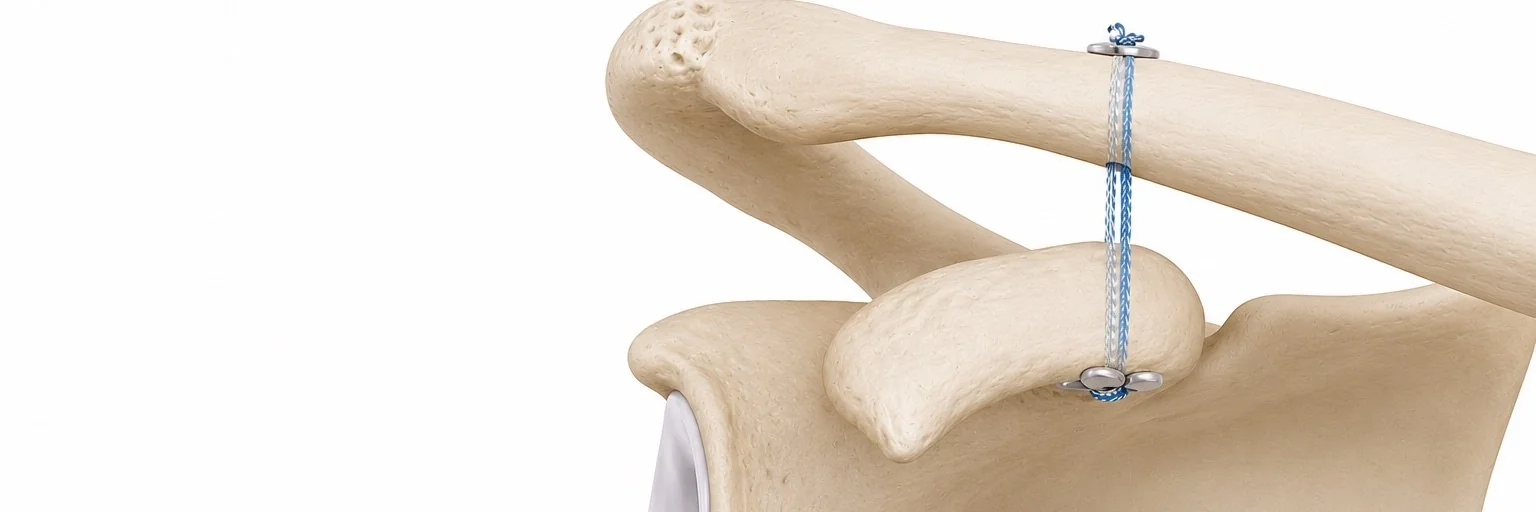
What is AC joint reconstruction?
AC joint reconstruction is a surgical procedure to restore the ligaments responsible for stabilising the joint between the collarbone (clavicle) and the acromion of the shoulder blade. When these ligaments are completely torn, the clavicle separates upward, producing the characteristic visible prominence on top of the shoulder.
Modern reconstruction techniques use a tendon graft (autograft or allograft) to recreate both the coracoclavicular ligaments (vertical stability) and the acromioclavicular ligaments (horizontal stability). Restoring both components is critical for durable long-term stability.
When is reconstruction needed?
Reconstruction is recommended for:
- high-grade acute injuries (Rockwood IV, V, VI)
- symptomatic grade III injuries with persistent instability or pain in active patients
- chronic painful AC joint instability
- failed previous AC joint surgery
How is the operation performed?
I perform AC joint reconstruction through a small incision over the superior aspect of the shoulder. The procedure includes:
- precisely positioned tunnels in the clavicle and the coracoid
- a tendon graft passed through the tunnels to recreate the coracoclavicular ligaments
- additional temporary fixation (often a button or screw) to support the reconstruction during biological healing
- reconstruction of the acromioclavicular ligaments themselves to restore horizontal stability
What should the patient expect after surgery?
- most procedures are performed as day-case surgery
- a sling is worn for 6 weeks to protect the reconstruction
- physiotherapy usually starts within the first postoperative week
- driving usually resumes at 6 weeks
- return to non-contact sports at 4 months
- return to contact and overhead sports at 6 months
What is the long-term outcome?
Modern AC joint reconstruction has excellent outcomes:
- 85–95% patient satisfaction in modern series
- most patients successfully return to their previous activities, including contact sport
- long-term stability is maintained when both vertical and horizontal components are restored