

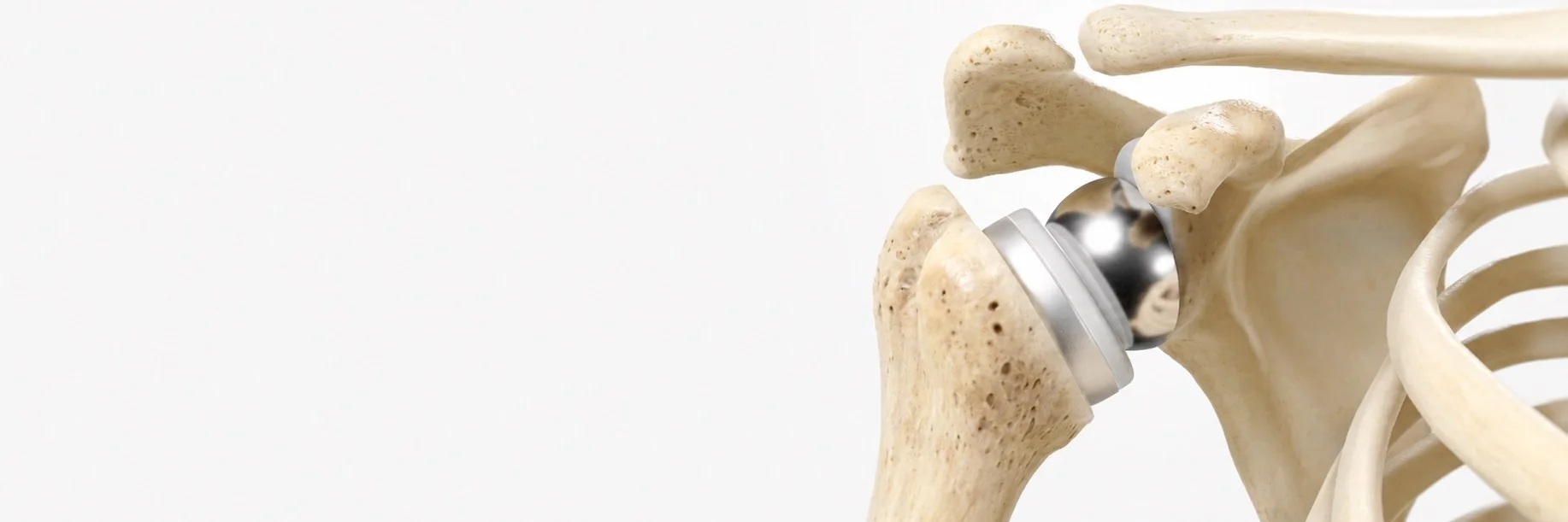
What is reverse shoulder replacement?
Reverse shoulder replacement is a modern shoulder replacement design that reverses the natural ball-and-socket geometry. Instead of placing a ball on the humerus and a socket on the glenoid (as in anatomic replacement), the implants are reversed: a ball is fixed to the glenoid and a socket to the top of the humerus.
This reversed geometry shifts the centre of rotation, allowing the deltoid muscle to lift the arm even when the rotator cuff is non-functional. It transformed shoulder surgery for patients who previously had no good option.
When is reverse replacement needed?
Reverse replacement is recommended for:
- rotator cuff arthropathy (arthritis with a deficient rotator cuff)
- massive, irreparable rotator cuff tears with significant functional loss
- failed previous shoulder replacement (revision surgery)
- fractures of the proximal humerus in elderly patients with poor bone quality
- inflammatory arthritis with severe glenoid bone loss
How is the operation performed?
I perform reverse shoulder replacement through a small incision in front of the shoulder. The procedure includes:
- careful exposure protecting the deltoid muscle (which becomes the primary mover after the operation)
- precise resection of the humeral head
- fixation of a baseplate and ball (glenosphere) to the glenoid
- preparation of the humerus and insertion of a socket-shaped component
- tensioning the deltoid appropriately to optimise function
What should the patient expect after surgery?
- hospital stay of 2–3 days
- a sling is worn for 4–6 weeks
- physiotherapy starts within the first days, with specific reverse-replacement protocols
- driving usually resumes at 6–8 weeks
- return to most daily activities by 3 months
- final functional gains continue for up to 12 months
What is the long-term outcome?
Reverse shoulder replacement has excellent and well-documented outcomes:
- most patients regain forward elevation above 120–140°
- reliable pain relief in over 90% of patients
- 10-year implant survivorship over 90% in modern series
External rotation may remain limited if the relevant cuff muscles are absent, a known feature of the reverse design.