

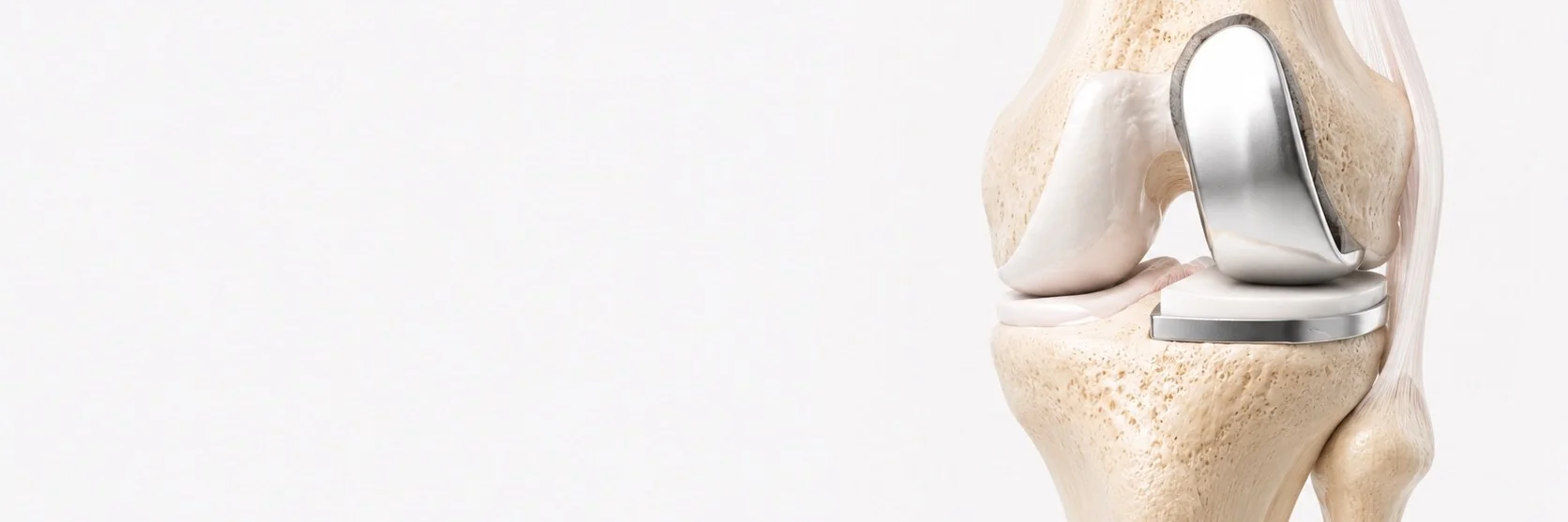
What is partial knee replacement?
The knee has three compartments, the medial (inner), lateral (outer) and patellofemoral (between the kneecap and the femur). When osteoarthritis is confined to just one of these compartments, partial knee replacement (also known as unicompartmental knee arthroplasty, UKA) replaces only the affected compartment, while preserving the remaining healthy structures of the knee.
Partial knee replacement is one of the most successful joint-preserving procedures in modern orthopaedics, when performed in the right patient, it gives a knee that often feels remarkably natural, with a faster recovery and excellent long-term function and patient satisfaction.
When is partial knee replacement appropriate?
Partial knee replacement is appropriate when:
- osteoarthritis is confined to a single compartment (most commonly the medial compartment)
- the cruciate ligaments remain intact and functional
- the remaining compartments are relatively preserved
- deformity is mild and correctable
- there is a satisfactory range of motion
Careful patient selection is essential. In appropriately selected patients, partial knee replacement provides excellent results. In poorly selected patients, outcomes are significantly less predictable, which is why the decision is made carefully, based on clinical examination and imaging findings.
What are the advantages over total knee replacement?
- smaller incision and reduced surgical trauma
- faster recovery, patients are often discharged within 1–2 days
- preservation of the cruciate ligaments and the unaffected compartments of the knee
- a more natural feeling knee, with better proprioception
- easier conversion to total knee replacement in the future if required
- lower complication rates compared with total knee replacement
- high patient satisfaction in appropriately selected patients
How is the operation performed?
Partial knee replacement is performed through a smaller incision compared with total knee replacement. Only the affected compartment is resurfaced, the femoral and tibial surfaces of that single compartment are replaced with anatomically shaped components, while the rest of the knee, including the cruciate ligaments and the meniscus of the unaffected compartment, is preserved.
Where appropriate, I use advanced technology-assisted techniques including robotic-assisted surgery, computer navigation, and patient-specific cutting guides to optimise implant positioning and alignment, tailored to each patient's individual anatomy.
I apply modern surgical techniques aiming for accurately positioned and well-balanced implants and rapid and reliable functional recovery.
What is the recovery?
- hospital stay typically 1–2 days
- weight-bearing as tolerated from the first postoperative day
- use of crutches is typically required for 1–2 weeks
- structured physiotherapy from the first post-operative day
- return to driving at approximately 3–4 weeks and to most daily activities by around 6 weeks
- return to low-impact sports (cycling, swimming, golf) often by 3 months
Patients often describe the recovery as significantly faster and easier than total knee replacement.
What are the long-term outcomes?
In well-selected patients, modern partial knee replacements have excellent long-term results, implant survival rates of approximately 90% at 10 years and 80% at 15 years are well documented in international registries. The combination of a more natural knee feel, faster recovery and good long-term implant durability makes it an excellent treatment option in the appropriately selected patient.