

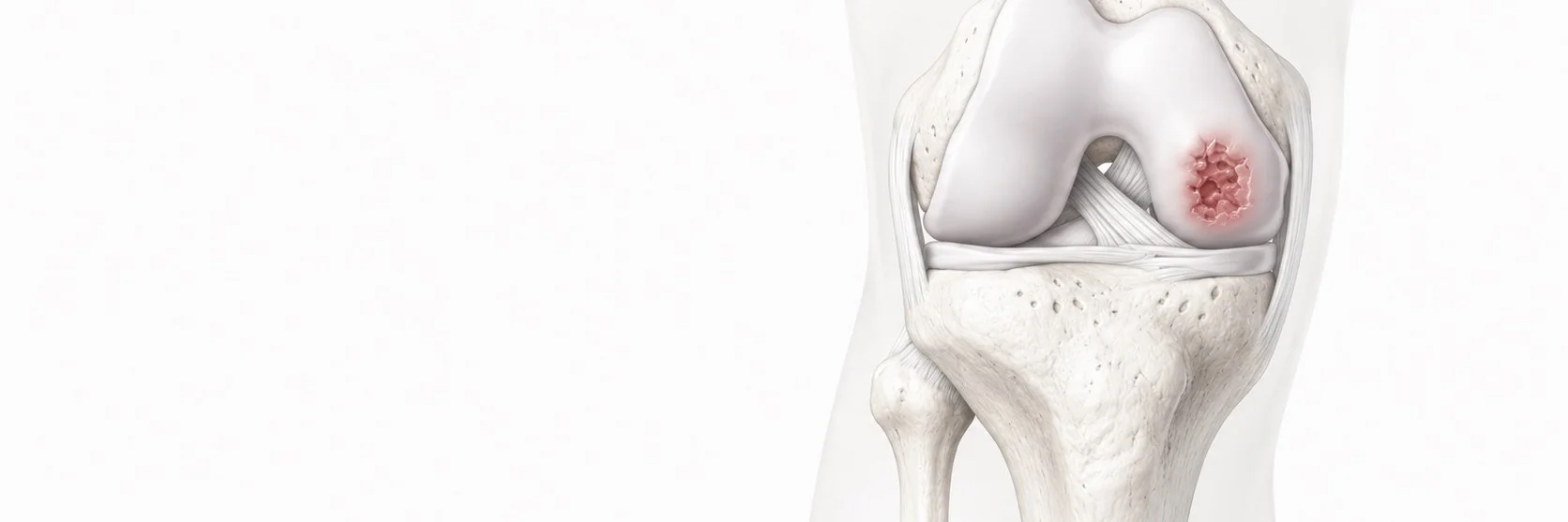
What is cartilage restoration?
Cartilage restoration is a group of surgical techniques designed to repair or replace damaged areas of articular cartilage in the knee. The goal is to restore the smooth, low-friction surface that allows the joint to move freely and and to protect the knee from progression to arthritis.
Modern techniques range from simple stimulation procedures (microfracture) to advanced biological restoration techniques (MACI, osteochondral autograft transfer). The right technique depends on the lesion size, depth, location and the patient’s age, activity level and goals.
When is cartilage restoration needed?
Cartilage restoration is considered in the following situations::
- a focal cartilage lesion is identified on imaging or arthroscopy
- symptoms persist despite conservative treatment
- the patient is young or middle-aged with many active years ahead
- the surrounding cartilage is healthy (focal damage, not widespread arthritis)
- any contributing malalignment or instability can be addressed simultaneously
What techniques are used?
For smaller lesions (under 2 cm²). Small holes are made in the underlying bone to release marrow stem cells, which form a fibrocartilaginous repair tissue. Simple, single-stage and effective for the right lesion.
For medium lesions. Microfracture is combined with a collagen scaffold that supports the repair process and produces more durable tissue than microfracture alone.
For larger lesions (2–10 cm²). A two-stage procedure: cartilage cells are harvested from the patient and grown on a scaffold in a laboratory, then implanted in a second operation. Produces cartilage with hyaline-like characteristics.
For deeper lesions involving both cartilage and underlying bone. Bone-and-cartilage plugs are transferred from a less-loaded part of the joint (autograft) or from a donor (allograft).
How is the operation performed?
Most cartilage restoration procedures are performed arthroscopically through small incisions, although some require a small open approach. The specific technique is chosen during the operation based on the true appearance of the lesion, sometimes different from the MRI appearance.
What should the patient expect after surgery?
Recovery depends on the technique used and the lesion location:
- protected weight-bearing for 6–8 weeks for most techniques
- a continuous passive motion (CPM) machine in the early weeks for some techniques
- physiotherapy starts immediately, focused initially on restoring motion before strength
- return to running typically at 6–9 months
- return to impact sport at 9–12 months, cartilage restoration requires long-term commitment
What is the long-term outcome?
Cartilage restoration outcomes vary by technique, lesion characteristics and patient factors:
- 70–85% of patients have substantial pain relief and functional improvement at 5 years
- MACI and AMIC produce more durable repair tissue than microfracture for larger lesions
- addressing malalignment alongside the cartilage work substantially improves outcomes