

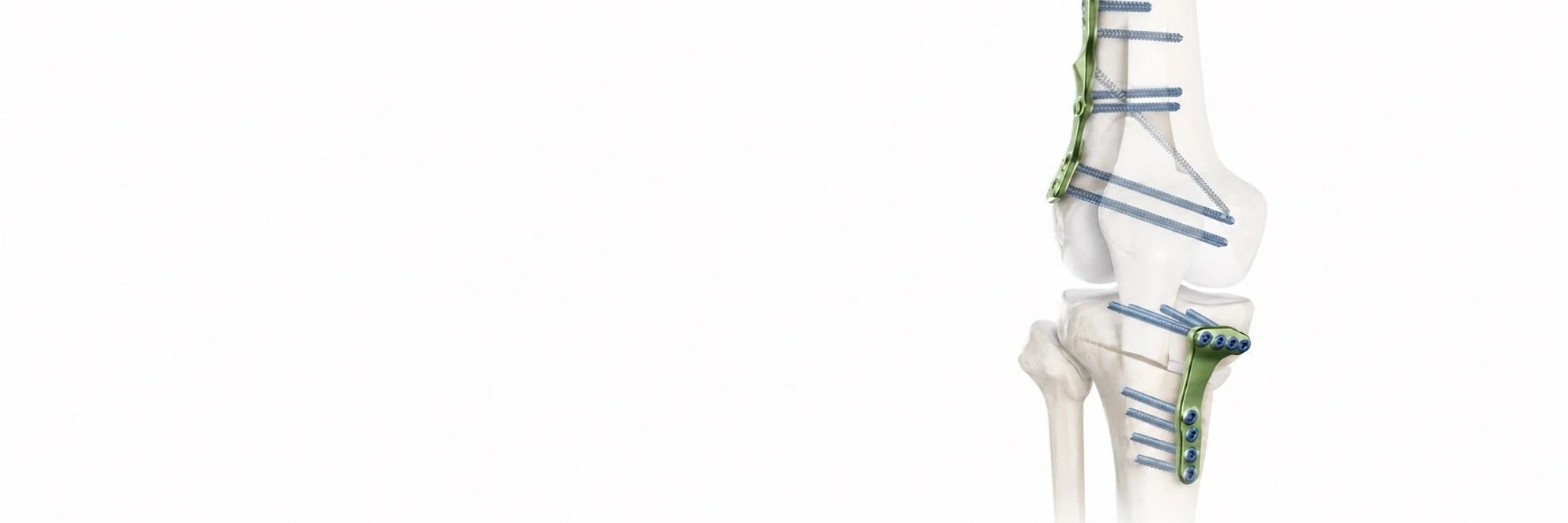
What is corrective osteotomy of the knee?
Corrective osteotomy is a precision operation in which the bone of the tibia or femur is divided and realigned to shift the mechanical axis of the leg. The goal is to redistribute load away from a worn or damaged compartment of the knee onto a healthy compartment, preserving the natural joint.
It is one of the cornerstones of joint-preserving knee surgery. In well-selected patients, osteotomy can delay or avoid the need for joint replacement for decades.
When is osteotomy needed?
Osteotomy is considered when:
- arthritis is confined to one compartment of the knee (typically the medial compartment in varus knees, or the lateral in valgus knees)
- the patient is younger and active, with substantial life and activity ahead
- malalignment is significant and contributes mechanically to the cartilage wear
- the ligaments are intact and the range of motion is preserved
- the patient wishes to avoid or delay knee replacement
How is the operation planned?
Osteotomy is unforgiving, small errors in planning translate into large errors in alignment. I plan every osteotomy meticulously:
- long-leg standing X-rays to measure the mechanical axis precisely
- CT or MRI when needed to assess cartilage and rotational alignment
- digital planning software to determine the exact correction angle and the wedge geometry
- pre-operative templating to confirm the planned correction will load the healthy compartment without overcorrecting
How is the operation performed?
The most common osteotomy I perform is a high tibial osteotomy (HTO) for varus knees with medial compartment arthritis. The principles are similar across the different osteotomy types:
- a precise cut is made through the tibia (or femur) using image guidance
- the bone is opened or closed to the planned angle, shifting the mechanical axis
- the corrected position is held with a modern fixation plate (I use the Newclip system, designed specifically for stable, anatomical osteotomy fixation)
- in opening-wedge osteotomies, bone graft or substitute may be added to fill the gap
What should the patient expect after surgery?
- hospital stay of 2–3 days
- partial weight-bearing on crutches for 6 weeks while the bone heals
- progressive loading from week 6, full weight-bearing usually by 8–10 weeks
- physiotherapy from day one, focused on range of motion and gentle quadriceps activation
- driving usually resumes at 6–8 weeks
- return to sport and demanding activities at 4–6 months
The fixation plate is generally left in place. It is only removed if it causes symptoms, uncommon with modern low-profile implants.
How important is rehabilitation?
Bone healing is biological, it takes time. Rehabilitation respects this:
- weeks 0–6: motion focus, partial weight-bearing
- weeks 6–12: progressive loading, strengthening
- months 3–6: full strengthening, sport-specific work
What is the long-term outcome?
Outcomes after well-planned osteotomy are very good in selected patients:
- 80–90% of patients have substantial pain relief and good function at 10 years
- most patients return to their previous activities, including most sports
- osteotomy delays or avoids knee replacement, often for 15–20 years or more
- when replacement is eventually needed, it is technically straightforward in most cases