

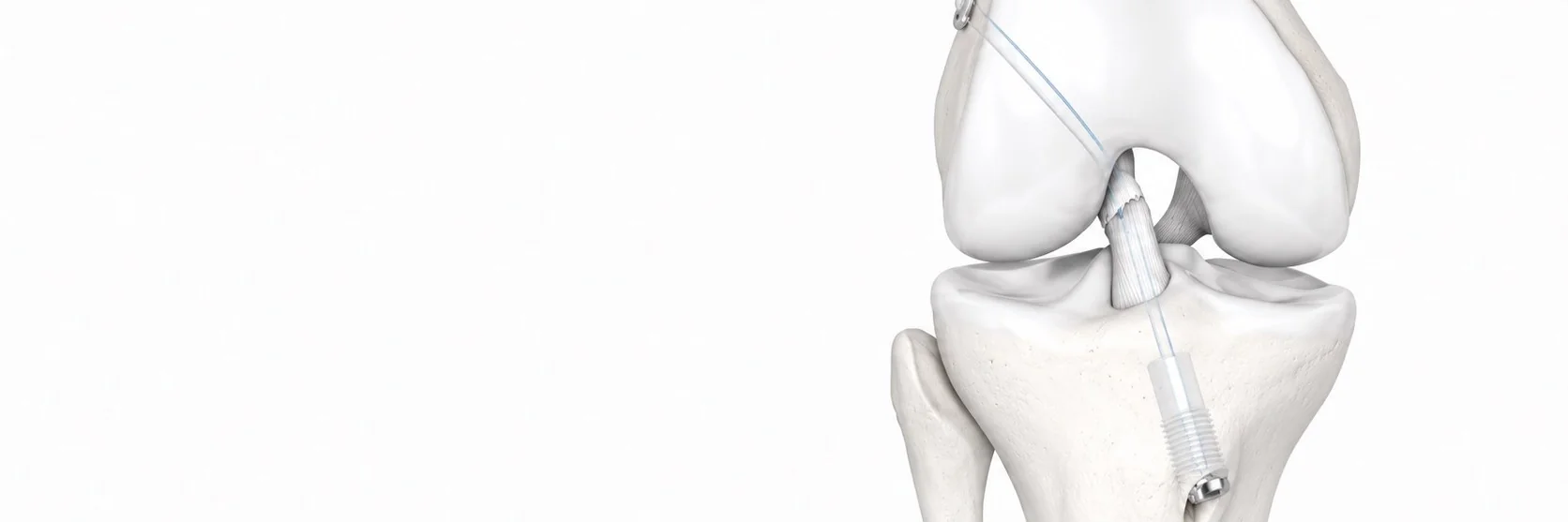
What is ACL repair with Ligamys®?
ACL repair with Ligamys® is a joint-preserving alternative to ACL reconstruction. Instead of replacing the torn ligament with a tendon graft, the patient’s own ligament is reattached at its anatomical footprint and protected during healing by a dynamic internal brace, the Ligamys® system, also known as Dynamic Intra-Ligamentary Stabilisation (DIS).
This is not a new idea, surgeons have attempted to repair the torn ACL for decades, with disappointing results. What changed is the engineering: the Ligamys® system maintains the torn ends in close apposition under physiological load, creating the conditions in which the ligament can biologically heal.
When is ACL repair indicated?
The indications are strict. ACL repair is suitable only when all of the following apply:
- acute injury, typically within three weeks, occasionally up to six weeks
- proximal tear pattern, the ligament has torn off the femoral attachment with adequate length and tissue quality
- good tissue quality on intra-operative inspection
- active, motivated patient, usually under 50, willing to follow a structured rehabilitation programme
- no major associated injury that would change the operative plan
How does the Ligamys® system work?
The system has three components working together:
- a strong braided polyethylene cord that runs through the knee along the path of the ACL
- a spring-loaded preload mechanism anchored in the tibia, applying continuous tension to the cord
- fixation in the femur and tibia, recreating the anatomical path of the native ligament
The torn ligament ends are sutured and brought back to the femoral footprint. The cord acts as an internal brace that takes the load while the ligament biologically heals, protecting the repair from being stretched out, while still allowing physiological motion. Over the following months, the patient's own ligament regenerates its blood supply and structural integrity, and the cord progressively becomes redundant.
How is the operation performed?
The procedure is performed arthroscopically, through the same small incisions used for any knee arthroscopy:
- a thorough arthroscopic examination confirms the tear pattern and tissue quality and addresses any associated meniscus or cartilage injury
- the torn ligament ends are carefully mobilised and reinforced with high-strength sutures
- tunnels are drilled at the anatomical femoral and tibial attachment sites
- the polyethylene cord is passed through both tunnels along the path of the original ACL
- the sutures from the ligament are tied to the cord, bringing the torn end back to the femoral footprint
- the spring-loaded preload mechanism is fixed in the tibia and tensioned, creating the dynamic internal brace
- knee stability is confirmed under direct arthroscopic visualisation through full range of motion
What should the patient expect after surgery?
- the procedure is most often performed as a day case
- crutches are used for 1–2 weeks with full weight-bearing as tolerated
- a knee brace is worn for the first 4–6 weeks, with progressive range of motion
- physiotherapy starts immediately, focused on swelling control and quadriceps activation
- driving usually resumes at 4–6 weeks (particularly after right knee surgery)
How long is the rehabilitation?
Rehabilitation after Ligamys® follows a similar timeline to reconstruction, with the same emphasis on protecting the healing ligament during the early months:
- weeks 0–6: range of motion, swelling control, gait training, brace protection
- weeks 6–12: progressive strengthening and proprioception
- months 3–6: running and sport-specific drills
- months 6–9: return to non-contact sport after successfully passing return-to-sport testing
- months 9–12: return to contact and pivoting sport
Because the timeline is broadly similar, the stage-by-stage guide Recovery after ACL reconstruction: what to expect also applies after Ligamys® repair.
What is the long-term outcome?
Published outcomes from the largest series show that, in well-selected patients:
- most patients regain a stable knee and return to their previous activity level
- re-tear or persistent instability or retear rates are reported in the range of 10–20%, somewhat higher than reconstruction in younger and high-demand patients
- when failure occurs, conversion to standard ACL reconstruction is straightforward and is not compromised by the previous repair
- preserved native ACL is associated with better proprioception and may reduce long-term abnormal joint loading