

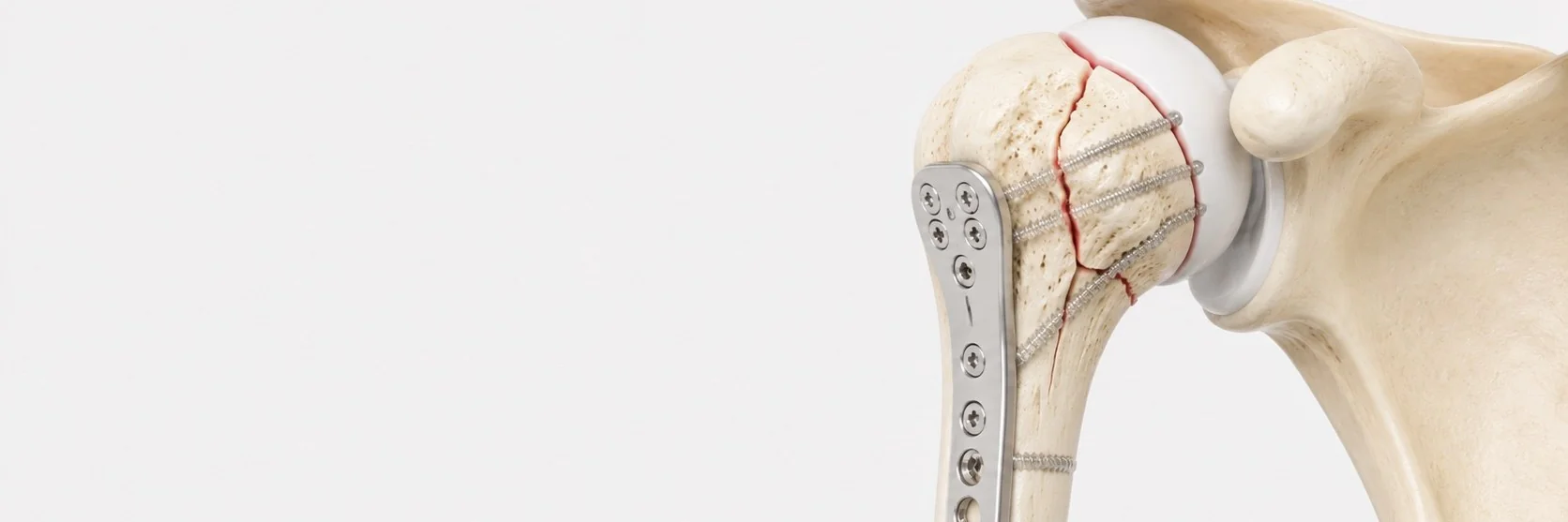
What does proximal humerus fracture surgery involve?
Proximal humerus fracture surgery is the surgical reconstruction of fractures of the upper end of the humerus near the shoulder joint. Modern techniques use fracture-specific locking plate systems, screws and sutures to restore the anatomy and provide stable fixation that supports early mobilisation.
For severely comminuted fractures in elderly patients with poor bone quality, where durable fixation is unlikely to be achievable, reverse shoulder replacement is often the more reliable option than attempted reconstruction.
When is surgery needed?
Surgery is recommended for:
- displaced two-, three-, and four-part fractures (Neer classification)
- fractures with significant angulation or rotation that would impair shoulder function
- fracture-dislocations
- open fractures or those with neurovascular compromise
How is the operation performed?
I perform proximal humerus fracture surgery through a minimally invasive deltoid-split approach, using the WINSTA-PH2 percutaneous locking plate system (Marquardt Medizintechnik, Germany). The system uses an anatomically pre-shaped, side-specific titanium plate with a dedicated targeting jig (Zielbügel) that allows screw placement through a genuinely percutaneous technique, the plate is slid submuscularly along the lateral humerus, then locked through small percutaneous stab incisions. This results in significantly less soft tissue dissection than a traditional open approach, while still allowing anatomical reduction and stable fixation. The procedure includes:
- a short split between the anterior and middle thirds of the deltoid, kept above the axillary nerve to protect it
- anatomical reduction of the fracture fragments under direct vision and fluoroscopic guidance
- percutaneous, jig-guided placement of the locking plate, sliding it submuscularly along the lateral humerus
- fixation with a fracture-specific locking plate system, with screws engaging the calcar (medial column) for support
- suture augmentation through the rotator cuff via the plate's dedicated suture holes, neutralising deforming muscular forces acting on the tuberosities
- final fluoroscopic confirmation of reduction in all planes
What should the patient expect after surgery?
- most patients remain in hospital for 1–2 nights
- a sling is worn for 4–6 weeks to protect the fixation
- passive shoulder mobilisation starts within the first postoperative days
- active motion usually begins from 4–6 weeks based on radiographic healing
- driving usually resumes at 6–8 weeks
- return to most daily activities by 3–4 months
- functional improvement continues progressively for up to 12 months
What is the long-term outcome?
Outcomes after well-performed proximal humerus fracture surgery are generally good:
- most patients regain functional shoulder movement and pain relief
- avascular necrosis of the humeral head can occur in severely displaced fractures (5–35% depending on pattern)
- malunion of the tuberosities is a known complication that affects rotator cuff function