

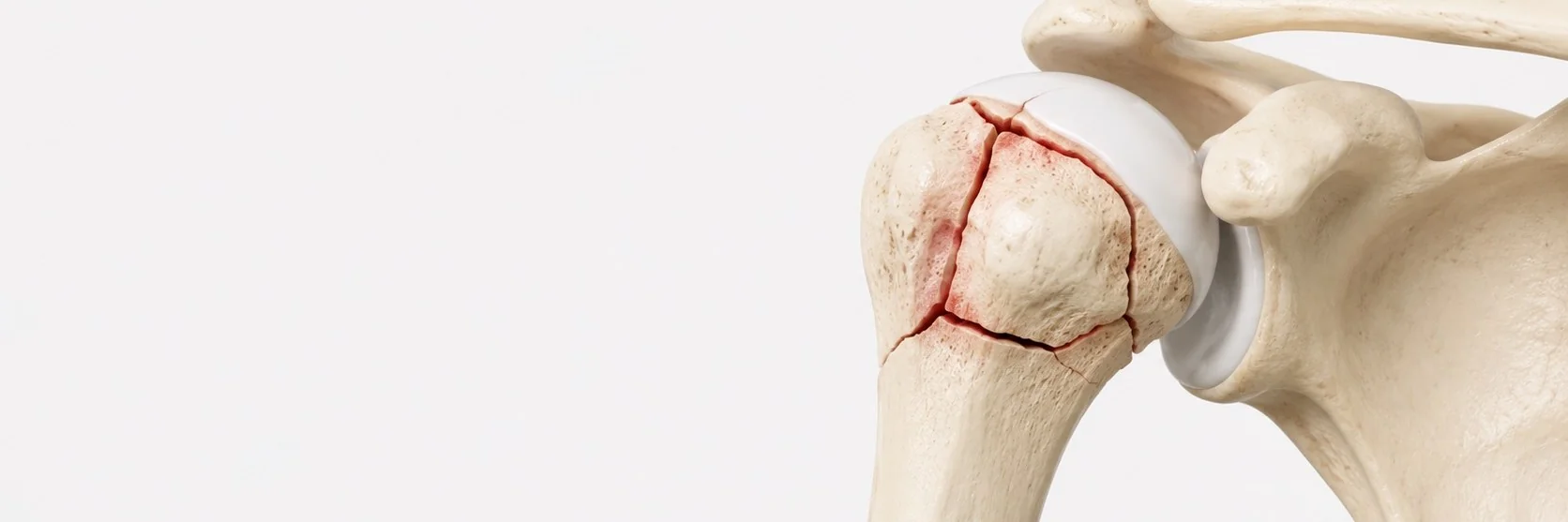
What is a proximal humerus fracture?
A proximal humerus fracture is a break in the upper end of the humerus, the part of the bone that forms the ball of the shoulder joint. These fractures range from simple, undisplaced cracks that heal predictably without surgery to complex four-part injuries that disrupt the blood supply to the humeral head and demand careful, often urgent, surgical decision-making.
Proximal humerus fractures are the third most common fracture in older adults and are also seen in younger patients after high-energy trauma. They are an area where modern reconstruction techniques have significantly improved outcomes, and where the choice between non-operative management, internal fixation and arthroplasty makes a real difference to long-term function.
What causes a proximal humerus fracture?
- low-energy falls in older adults with osteoporosis (the great majority of cases)
- high-energy trauma in younger patients, road traffic accidents, falls from height, sport
- direct blow to the shoulder
- shoulder dislocation in older patients (often combined with a fracture)
- pathological fractures from underlying bone disease
What are the symptoms?
- severe pain in the shoulder immediately after the injury
- marked swelling and bruising, often spreading down the arm and into the chest wall over the following days
- inability to move the arm
- the arm is typically held still against the body
- in displaced fractures, an obvious change in shoulder contour
How is the diagnosis made?
- clinical history and examination, including assessment of the neurovascular status of the arm
- X-rays of the shoulder in multiple views, usually diagnostic
- CT scan with three-dimensional reconstruction in displaced or complex fractures, essential for preoperative planning
- MRI in selected cases when associated rotator cuff injury is suspected
How are these fractures classified?
Proximal humerus fractures are classified by the number of fragments and their displacement, most commonly using the Neer classification, one-part, two-part, three-part and four-part fractures. The classification is important because it directly influences treatment: a four-part fracture, for example, has a high risk of disrupting the blood supply to the humeral head and may need replacement rather than fixation.
What is the conservative treatment?
Around 80% of proximal humerus fractures are minimally displaced and heal well without surgery. The conservative protocol typically involves:
- a sling for comfort, usually for 2–3 weeks
- early gentle pendulum exercises to prevent stiffness
- progressive physiotherapy starting around 2–3 weeks once the fracture is stable
- regular X-ray review to confirm healing and rule out displacement
The key thing is that early controlled mobilisation is essential, too long in a sling produces a stiff, painful shoulder that is much harder to rehabilitate than the fracture itself.
When is surgery required?
Surgery is considered for:
- significantly displaced fractures, particularly in active patients
- fracture-dislocations
- open fractures or fractures with neurovascular compromise
- fractures with a high risk of avascular necrosis of the humeral head
- selected fractures in younger, active patients where anatomical restoration improves long-term function
What are the surgical options?
The choice of operation depends on the fracture pattern, bone quality and patient factors:
- open reduction and internal fixation (ORIF) with a locking plate, the workhorse procedure for two- and three-part fractures, and for four-part fractures in younger patients with good bone quality
- intramedullary nailing in selected fracture patterns
- hemiarthroplasty (replacing the humeral head only), reserved for highly comminuted fractures in older patients with intact rotator cuff
- reverse total shoulder arthroplasty, increasingly the procedure of choice for complex displaced four-part fractures in older patients, where it gives more reliable function than fixation or hemiarthroplasty
I apply modern surgical techniques aiming for stable fixation, minimal soft tissue trauma, and early controlled mobilisation. The decision between fixation and replacement is made carefully on a case-by-case basis after detailed discussion with the patient.
What should the patient expect after surgery?
- hospital stay of typically 1–3 days
- the arm is placed in a sling for protection
- early gentle physiotherapy under guidance, starting in the first post-operative week
- the sling is gradually weaned over 4–6 weeks
- active strengthening progresses from approximately 6 weeks
- return to driving at 6–8 weeks and to most daily activities by 3 months
- full functional recovery typically takes 6–12 months
One point I keep coming back to is that the patient's commitment to the rehabilitation programme is as important as the operation itself. A well-fixed fracture in a stiff shoulder is a poor outcome, early and consistent physiotherapy is what turns a successful operation into a successful result.