

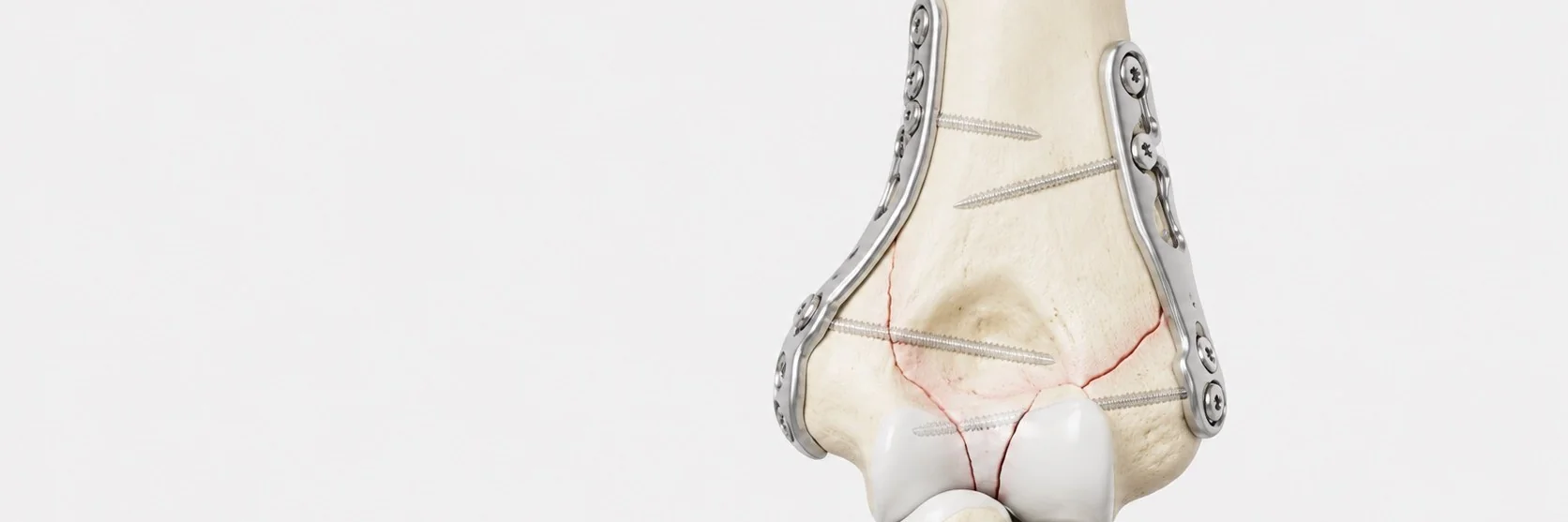
What does distal humerus fracture surgery involve?
Distal humerus fracture surgery is the surgical reconstruction of fractures at the lower end of the humerus, where the humerus forms the upper half of the elbow joint. These fractures often involve the joint surface itself, and they require precise anatomical reduction and stable internal fixation to restore a stable and functional elbow.
Patterns include supracondylar fractures (above the joint), transcondylar fractures (through the condyles, often in elderly patients with osteoporotic bone), and intra-articular bicondylar (T- or Y-pattern) fractures that split the joint surface in two planes. Each fracture pattern presents different surgical challenges.
When is surgery needed?
Surgery is the standard treatment for almost all displaced distal humerus fractures in adults, because the elbow tolerates malunion particularly poorly and stiffness resulting from prolonged immobilisation is often difficult to reverse. Specific indications include:
- any displaced intra-articular fracture (T-, Y-, or single column)
- displaced supracondylar fractures with angulation or shortening
- transcondylar fractures in elderly patients where stable fixation permits early mobilisation
- open fractures or those with neurovascular compromise (the ulnar nerve runs immediately behind the medial condyle)
- fractures with associated elbow dislocation
How is the operation performed?
I perform distal humerus fracture surgery through a posterior surgical approach to the elbow. The procedure includes:
- protection and careful mobilisation of the ulnar nerve at the medial side
- for intra-articular patterns, an olecranon osteotomy, a controlled cut of the olecranon, to allow full exposure of the joint surface and allow anatomical reduction under direct vision
- anatomical reduction of the articular fragments first, temporarily or definitively fixed with small screws to reconstruct the joint as a single block
- fixation of the medial and lateral columns to the humeral shaft using two contoured locking plates (one on each side), creating one of the strongest mechanical fixation constructs available
- repair of the olecranon osteotomy with tension-band wiring or a dedicated plate
- fluoroscopic confirmation of reduction and elbow range of motion intraoperatively
What should the patient expect after surgery?
- most patients spend 2–3 nights in hospital
- the elbow is supported in a sling, but active mobilisation typically begins on the first or second day, early movement is essential to prevent stiffness
- structured physiotherapy over several months to regain range of motion
- driving usually resumes at 6–8 weeks once motion is functional
- return to manual labour and most activities by 3–4 months
- functional improvement can continue progressively for up to 12 months
What is the long-term outcome?
With anatomical reduction, stable dual-plate fixation and early rehabilitation, outcomes after distal humerus surgery are good for most patients:
- most patients regain a functional arc of elbow motion (approximately 30°–130°)
- some loss of terminal extension is common but rarely affects daily function
- recognised complications include heterotopic ossification, ulnar neuritis, and stiffness, all of which are reduced through careful surgical technique and early mobilisation
- nonunion is uncommon with modern dual-plate constructs