

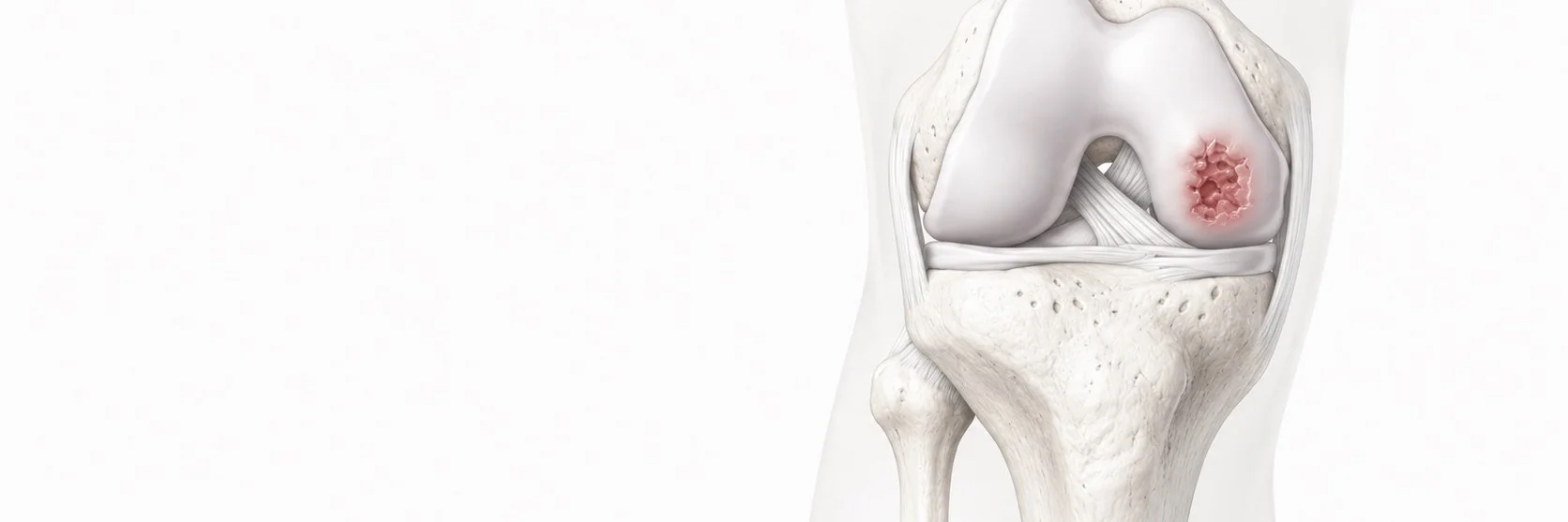
What are cartilage lesions?
Articular cartilage is a smooth, durable, low-friction tissue that covers the surfaces of joints. It is what allows the knee to move smoothly and painlessly under load. It is also remarkably poor at healing, it has no blood supply, and once it is damaged, it cannot easily regenerate on its own.
A cartilage lesion is any area of damage to this critical surface. Lesions can range from mild softening to deep, full-thickness defects exposing the underlying bone.
What causes cartilage lesions?
- acute trauma, sporting injuries, twisting injuries, dislocations
- previous ligament or meniscus injury
- joint malalignment that overloads one compartment
- osteochondritis dissecans
- repetitive overuse
- early degenerative change
What are the symptoms?
- knee pain, particularly with weight-bearing and activity
- swelling, often recurrent
- mechanical symptoms, clicking, catching, occasional locking when a fragment is loose
- stiffness
- in some cases, the lesion is asymptomatic and detected incidentally
How is the diagnosis made?
- clinical history and examination
- X-rays, exclude bony pathology and assess overall alignment
- MRI, the most important investigation, allowing detailed assessment of the size, depth and location of the lesion and the state of the surrounding bone and meniscus
Cartilage lesions are graded according to the Outerbridge classification, from Grade 1 (softening) to Grade 4 (full-thickness loss exposing bone).
What is the conservative treatment?
In small or mild lesions, conservative treatment may control symptoms and slow progression:
- activity modification
- anti-inflammatory medication
- physiotherapy with strengthening and joint mobility
- weight management
- intra-articular hyaluronic acid
- Molecular & Biological Regenerative Therapy (PRP)
It is worth being clear that conservative treatment cannot regenerate damaged cartilage, but it can meaningfully reduce symptoms and delay progression in many patients.
When is surgery needed?
Surgery is considered when:
- the lesion is large or unstable
- symptoms persist despite conservative treatment
- there are mechanical symptoms
- there is associated meniscus or ligament pathology
Arthroscopic cartilage treatment
Many cartilage lesions can be addressed arthroscopically through small incisions:
- debridement of unstable cartilage
- removal of loose bodies
- microfracture or related marrow-stimulation techniques in small lesions
- treatment of associated pathology
Modern cartilage restoration techniques
For larger and more complex defects, modern cartilage restoration techniques can rebuild the damaged surface. I draw on training at one of the largest cartilage centres in Europe and apply contemporary, predominantly single-stage techniques:
- Minced Cartilage technique, small fragments of the patient's own cartilage are harvested and re-implanted into the defect, supporting biological repair in a single operation
- in selected cases, advanced restoration with autologous chondrocyte implantation or osteochondral grafting
I apply modern, biologically-driven techniques aiming for stable, durable cartilage repair.
What about combined procedures?
Cartilage lesions rarely exist in isolation. Where the underlying problem is malalignment, meniscus deficiency or ligament insufficiency, treating the cartilage alone will fail. I therefore frequently combine cartilage restoration with:
- corrective osteotomy to offload the affected compartment
- meniscus repair or transplantation when indicated
- ligament reconstruction
Treating the joint as a whole, not just the visible defect, is the key to durable results.
What should the patient expect after surgery?
- protected weight-bearing for 6–12 weeks, depending on what was performed
- structured rehabilitation that takes into account cartilage maturation
- full cartilage maturation can take up to 12 months
- return to running typically at 4–6 months and to sport at 6–9 months, depending on the procedure