

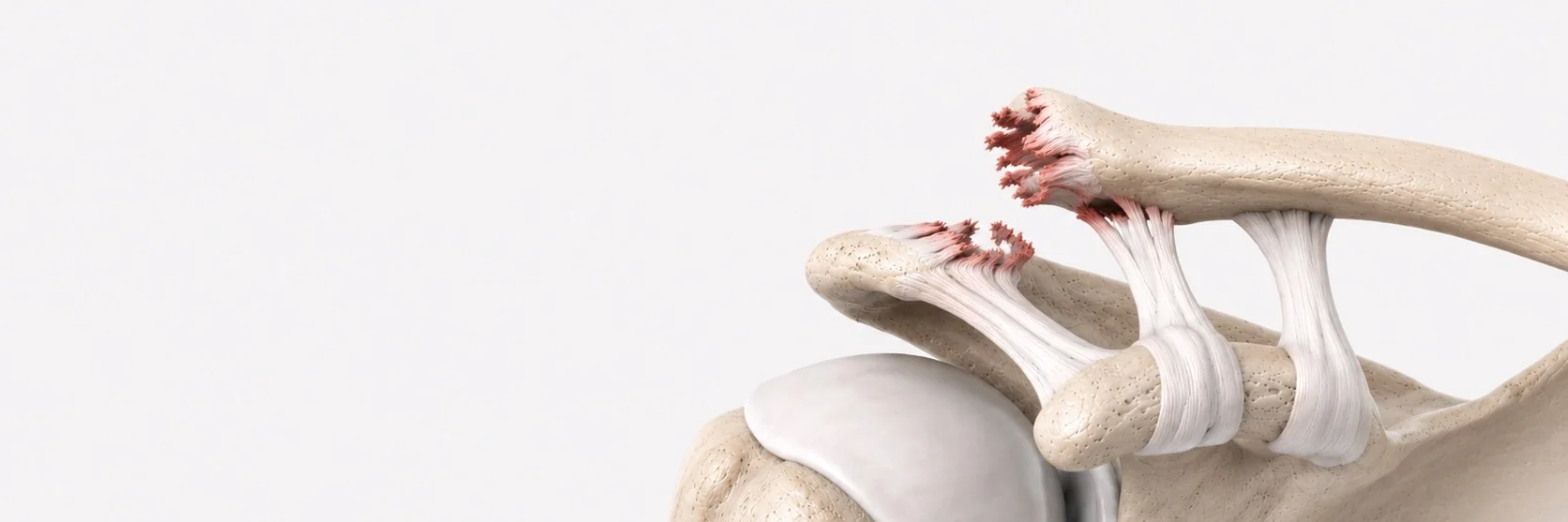
What is the acromioclavicular (AC) joint?
The acromioclavicular (AC) joint is the small but important joint between the outer end of the clavicle and the acromion of the scapula. It is held together by capsular ligaments and, more importantly, by the powerful coracoclavicular ligaments below.
AC joint injuries range from a mild sprain to a complete dislocation with significant displacement of the clavicle.
What causes AC joint injuries?
The vast majority occur from a direct fall onto the point of the shoulder, common in cycling, contact sports, skiing and motor vehicle accidents. A fall onto an outstretched arm is a less common mechanism.
How are AC joint injuries classified?
Injuries are usually graded according to the Rockwood classification:
- mild injury, stretching of the ligaments without displacement
- moderate injury, partial rupture with mild displacement
- severe injury, complete rupture with significant upward displacement of the clavicle
Higher-grade injuries (with marked or buttonhole displacement, or with the clavicle displaced through muscle) are increasingly likely to require surgical treatment.
What are the symptoms?
- pain over the top of the shoulder
- swelling and bruising over the AC joint
- a visible step or prominence over the joint in higher-grade injuries
- pain with overhead movement, with carrying weight, or when reaching across the body
How is the diagnosis made?
Diagnosis is based on clinical examination supported by:
- X-rays, including dedicated AC joint views and, where needed, weighted comparison views
- MRI, for high-grade injuries or when associated rotator cuff or labral pathology is suspected
What is the conservative treatment?
The majority of low-grade AC joint injuries are managed without surgery. The plan typically includes:
- a sling for comfort, usually for 1–3 weeks depending on severity
- ice and anti-inflammatory medication
- early gentle range of motion exercises
- a progressive physiotherapy programme
- Molecular & Biological Regenerative Therapy (PRP) in selected cases of persistent AC joint pain
I want patients to understand that early treatment can improve symptom control and the speed of return to activity. Most low-grade injuries recover well within 6–12 weeks.
When is surgery required?
Surgery is considered in:
- high-grade injuries with significant displacement, particularly in younger active patients
- patients with persistent pain, weakness or scapular dysfunction after a properly conducted conservative programme
- chronic AC joint instability
How is surgical treatment performed?
Modern AC joint surgery focuses on anatomic reconstruction of the coracoclavicular ligaments. Depending on the case, I use:
- arthroscopically-assisted reconstruction with strong synthetic suture devices
- biological augmentation with tendon graft in chronic or revision cases
- additional treatment of any associated intra-articular pathology
I apply modern arthroscopic techniques aiming for stable repair and optimal functional recovery.
What should the patient expect after surgery?
- a sling for approximately 4–6 weeks
- early gentle range of motion under physiotherapy guidance
- progressive strengthening from 6–8 weeks
- return to contact sport typically around 4–6 months