

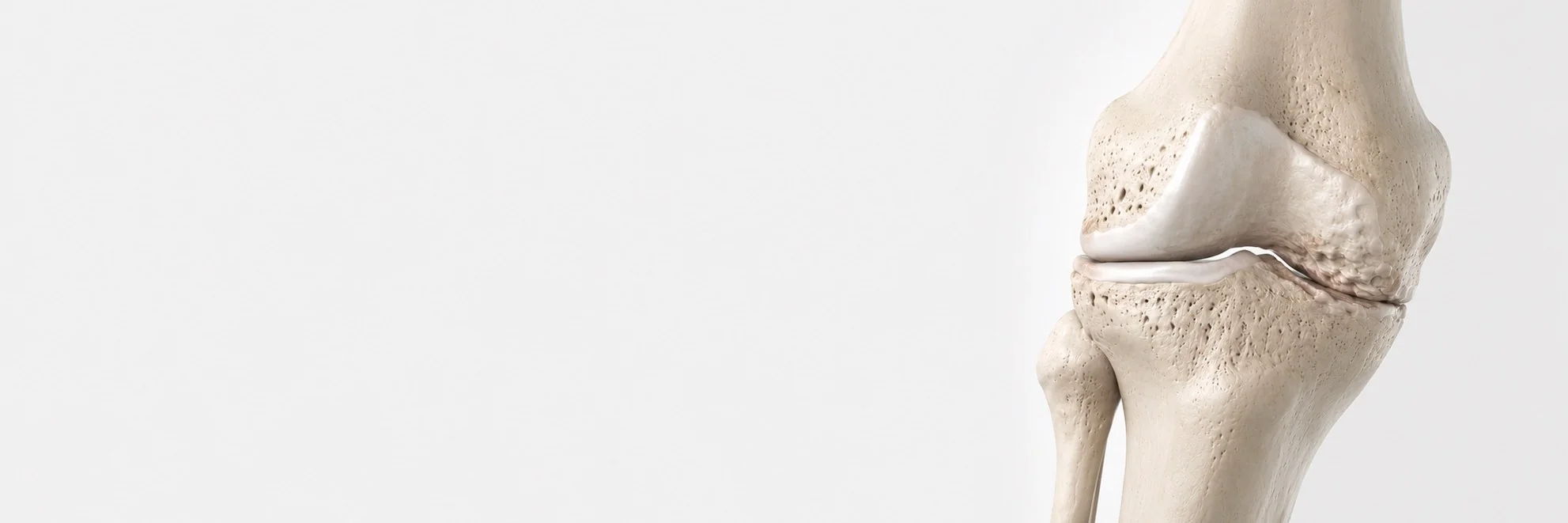
What is knee malalignment?
Knee malalignment is an abnormal mechanical axis of the lower limb. Instead of load passing evenly through the centre of the knee, it is concentrated on one compartment, the inner side in varus ("bow legs") or the outer side in valgus ("knock knees"). Over time, this uneven loading damages the cartilage, the meniscus and eventually the entire joint.
Identifying and correcting malalignment is one of the most important, and most under-used, interventions in modern joint preservation surgery.
What causes varus or valgus deformity?
- natural anatomical variation
- previous fracture, particularly malunion of the tibial plateau or distal femur
- post-meniscectomy degeneration
- developmental conditions, including growth-plate disorders in childhood
- rickets and other metabolic bone diseases
- in some cases, the result of established osteoarthritis itself
What are the symptoms?
- pain on the overloaded side of the knee
- stiffness, particularly after activity
- swelling
- the patient or family may notice the alignment problem
- in long-standing cases, progressive bowing of the leg and difficulty walking
How is the diagnosis made?
- clinical examination, observation of standing alignment, gait analysis
- long-leg standing X-rays, the cornerstone of diagnosis, allowing precise measurement of the mechanical axis
- weight-bearing knee X-rays to assess the affected compartment
- MRI, to assess cartilage, meniscus and other soft tissues
- CT scan in selected cases for detailed bony assessment and surgical planning
What is the conservative treatment?
Conservative treatment aims to control symptoms but does not correct the underlying mechanical problem:
- weight management
- anti-inflammatory medication
- physiotherapy
- intra-articular injections, including Molecular & Biological Regenerative Therapy (PRP)
- offloading braces in selected cases
I emphasise that, when malalignment is the underlying cause, only correction of the mechanical axis can address the root of the problem.
When is corrective osteotomy recommended?
Corrective osteotomy is considered when:
- there is single-compartment overload due to malalignment
- symptoms persist despite conservative treatment
- the patient is younger and active and total knee replacement is not the right next step
- there is associated cartilage or meniscus pathology that needs addressing alongside the alignment
What is an osteotomy?
An osteotomy is a modern joint-preserving procedure in which a controlled cut is made in the bone to correct the mechanical axis of the lower limb. Depending on the case, the bone may be opened up (opening-wedge) or closed down (closing-wedge), and the correction may be made on the tibial side (high tibial osteotomy) or the femoral side (distal femoral osteotomy).
It is one of the most misunderstood yet highly effective procedures in modern orthopaedic surgery, with success rates reported in international studies of up to 96% in well-selected patients.
Why is osteotomy important?
In many patients with single-compartment knee pain, the true underlying problem is the abnormal mechanical axis, not just the meniscus or the cartilage. A simple meniscectomy or arthroscopic procedure may give temporary relief but does not address the cause of the overload, and can even accelerate joint wear.
Corrective osteotomy addresses the root cause. By rebalancing the axis, load is shifted away from the damaged compartment onto the healthy side, allowing pain to settle and slowing, sometimes halting, the progression of arthritis.
What are the benefits?
- delays or even prevents the need for partial or total knee replacement
- preserves the natural joint and the cruciate ligaments
- allows continued active lifestyle, including return to sport in many patients
- particularly valuable in younger and active patients
- even when knee replacement is eventually needed, osteotomy can significantly delay it, buying years of active life
How is the procedure performed?
Before surgery, I create a detailed individualised plan based on:
- long-leg standing X-rays
- MRI to assess the cartilage, meniscus and other structures
- CT-based 3D planning in complex cases
I use patient-specific cutting guides and modern locking-plate systems (such as the Newclip osteotomy system), allowing correction with millimetre precision. I trained in Germany in advanced corrective osteotomy and joint preservation surgery, and apply modern surgical techniques aiming for stable fixation, accurate correction and the fastest possible functional recovery.
In experienced hands, osteotomy can provide excellent long-term results for 10 years or more, depending on the patient's activity and the state of the joint.
What should the patient expect after surgery?
- hospital stay of 1–3 days
- knee brace for 6 weeks
- protected weight-bearing for 6 weeks
- structured physiotherapy from the first post-operative week
- return to running typically at 4–6 months
- return to sport at 6–9 months, depending on healing