

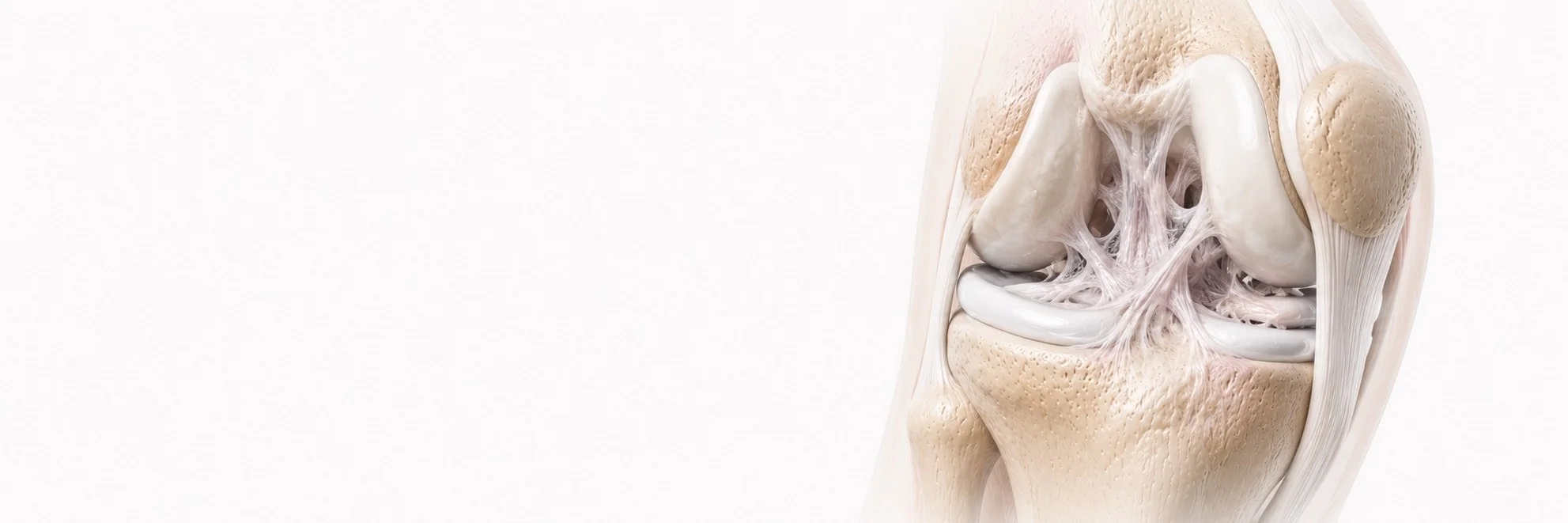
What is knee stiffness?
Knee stiffness is the loss of normal range of motion, the inability to fully bend or straighten the knee. Most knees should reach full extension (0°) and flex to about 130–140° during normal use.
When the range falls below the normal threshold and persists, the underlying cause is most often arthrofibrosis, the formation of excess scar tissue inside and around the knee that mechanically restricts movement.
What causes it?
Knee stiffness most often develops:
- after surgery, particularly knee replacement, ACL reconstruction or fracture fixation
- after trauma, fractures, ligament injuries, dislocations
- after prolonged immobilisation, extended use of a brace or cast
- in association with infection or inflammatory arthritis
- rarely, without an identifiable trigger (idiopathic arthrofibrosis)
Some patients are also genetically more prone to forming scar tissue, and respond more dramatically to surgery or injury.
What are the symptoms?
- inability to fully straighten the knee (loss of extension)
- inability to bend the knee fully (loss of flexion)
- pain at the end ranges of motion
- difficulty walking normally, going up or down stairs
- a sense of the knee being "tight" or "locked up"
- swelling and warmth in active arthrofibrosis
How is it diagnosed?
- careful clinical examination, measuring the range of motion in both knees
- X-rays to assess any underlying bony cause (malposition of components after replacement, fracture malunion)
- MRI to identify scar tissue and any associated soft-tissue pathology
- review of operative reports and rehabilitation history when relevant
What is the conservative treatment?
The first line of treatment is intensive, structured rehabilitation:
- daily physiotherapy with passive and active range-of-motion exercises
- home stretching programmes, often multiple times daily
- continuous passive motion (CPM) machine in selected cases
- anti-inflammatory medication and pain control to allow effective rehabilitation
- occasionally, intra-articular corticosteroid injection to reduce inflammatory contribution
A 6–12 week trial is typically appropriate before considering surgical intervention.
When is surgery considered?
Surgical treatment is considered when:
- range of motion has plateaued despite a structured rehabilitation programme
- the loss of motion significantly impairs daily function
- imaging confirms scar tissue or a mechanical block to motion
Surgical options include:
- manipulation under anaesthesia, for early stiffness, particularly in the first 12 weeks after a procedure
- arthroscopic arthrolysis, for established arthrofibrosis with identifiable scar bands
- open release, rarely needed, reserved for the most severe cases
How is arthroscopic arthrolysis performed?
I perform arthroscopic arthrolysis through small incisions, working inside the knee with specialised instruments. The procedure includes:
- identifying the scar bands restricting motion
- releasing scar tissue selectively, taking care to preserve normal anatomy
- addressing any associated mechanical issues
- confirming restored range of motion under anaesthesia before closure
What should the patient expect after surgery?
- physiotherapy starts within the first 24 hours, early motion is essential
- an intensive rehabilitation programme over the first 6–12 weeks
- home stretching programmes continue for several months
- most patients regain functional motion within 3 months
- the risk of recurrent stiffness must be monitored carefully throughout
What is the long-term outcome?
Outcomes after treatment of knee stiffness depend heavily on early recognition and committed rehabilitation. Most patients regain functional range of motion when the underlying cause is addressed and the rehabilitation programme is followed consistently.