

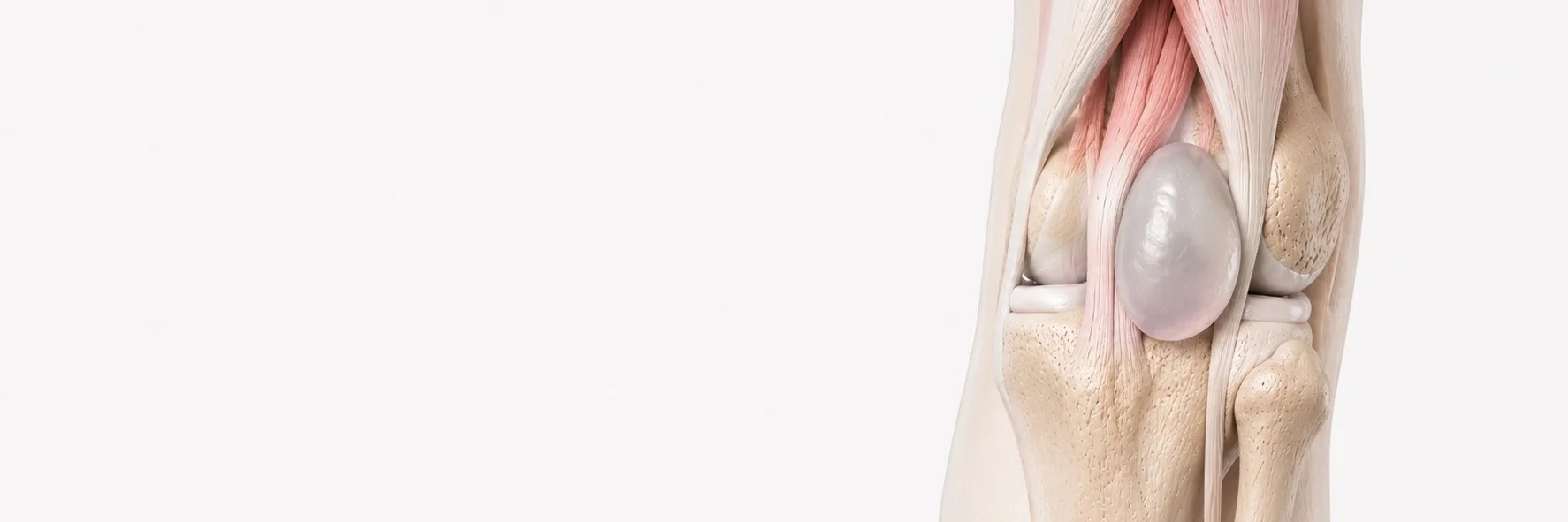
What is a Baker's cyst?
A Baker's cyst (also called a popliteal cyst) is a fluid-filled swelling at the back of the knee. It forms when the synovial fluid that normally lubricates the joint accumulates in a sac that bulges out behind the knee.
In adults, a Baker's cyst is almost always secondary to another problem inside the knee, most commonly a meniscus tear or osteoarthritis. The underlying joint condition produces excess fluid, which finds its way into the cyst.
What are the symptoms?
- a visible or palpable lump at the back of the knee
- tightness or pressure behind the knee, especially with deep flexion
- swelling that fluctuates with activity
- occasionally, calf pain if the cyst ruptures and fluid tracks down the leg
- symptoms of the underlying knee problem (joint-line pain, stiffness)
How is it diagnosed?
- clinical examination, the cyst is usually palpable behind the knee
- ultrasound, confirms the cyst and excludes a deep vein thrombosis (DVT)
- MRI, visualises the cyst and identifies the underlying knee pathology
To be clear, the most important question with a Baker's cyst is not the cyst itself, it's what's causing it. The investigation should be aimed at finding the underlying joint problem.
How is it treated?
Treatment depends on the underlying cause and the severity of symptoms:
- small asymptomatic cysts, usually need no treatment, just observation
- symptomatic cysts, treatment of the underlying joint problem (meniscus surgery, arthritis management)
- large painful cysts, ultrasound-guided aspiration and corticosteroid injection
- recurrent cysts, surgical excision is rarely needed and only considered after other options
In most cases, treating the underlying cause causes the cyst to resolve naturally.
When should I be concerned?
A Baker's cyst should be evaluated when:
- the swelling is large or progressively enlarging
- there is significant pain, stiffness or limitation of activity
- sudden calf pain, swelling or redness develops, this requires urgent assessment to exclude DVT or cyst rupture
- there is associated knee pain or mechanical symptoms suggesting an internal joint problem