

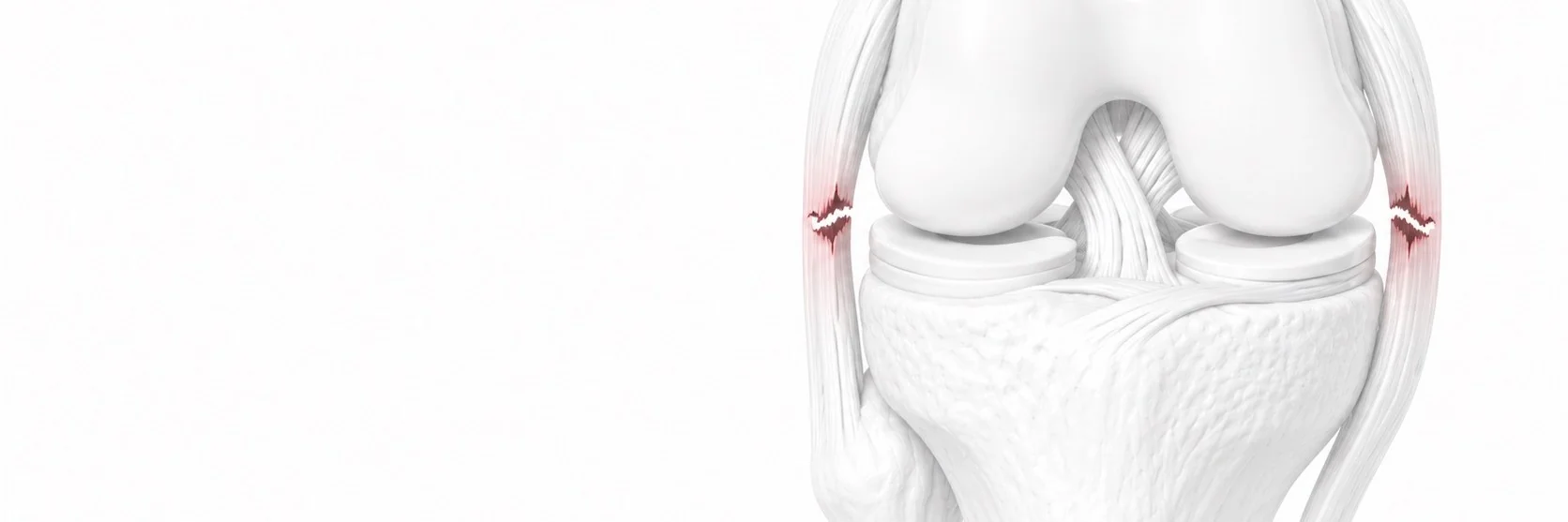
What is an MCL injury?
The medial collateral ligament (MCL) runs along the inner side of the knee, from the femur to the tibia. It is the primary restraint against valgus stress (forces that push the knee inwards). MCL injuries are the most common ligamentous injuries of the knee, far more common than ACL tears, and the great majority heal well with non-surgical treatment.
What causes an MCL injury?
- a direct blow to the outer side of the knee (a common football and rugby mechanism)
- a non-contact valgus stress, landing or twisting with the knee bending inwards
- skiing injuries
- high-energy trauma producing multi-ligament injury
What are the symptoms?
- pain on the inner side of the knee
- swelling localised to the medial side rather than the whole joint
- tenderness directly over the MCL on examination
- instability or a feeling of the knee "opening up" under load
- difficulty with cutting and pivoting
How is the diagnosis made?
- clinical examination, including the valgus stress test at 0° and 30° of flexion
- X-rays, to exclude bony injury
- MRI, to confirm the diagnosis, grade the injury and identify any associated injuries (ACL, meniscus, cartilage)
How are MCL injuries graded?
- Grade I, sprain with intact fibres, mild laxity
- Grade II, partial tear, moderate laxity but a definite endpoint
- Grade III, complete tear, no endpoint, gross instability
What is the conservative treatment?
The MCL has an excellent capacity to heal, much better than the ACL. Conservative treatment is the first-line management for the great majority of isolated MCL injuries, including most Grade III tears:
- hinged knee brace to protect the ligament during healing, typically 4–6 weeks for Grade II, 6–8 weeks for Grade III
- early protected weight-bearing as tolerated
- structured physiotherapy with progressive range of motion and strengthening
- graduated return to running and then to sport
I make a point of explaining that early treatment with the right brace and a properly conducted rehabilitation programme gives excellent results in the great majority of patients.
When is surgery considered?
Surgery is considered in:
- Grade III injuries with persistent instability after conservative treatment
- MCL avulsion injuries (where the ligament has detached with a fragment of bone)
- multi-ligament knee injuries where the MCL is part of a wider injury
- chronic MCL deficiency with persistent symptoms
How is surgical treatment performed?
When surgery is required, I perform either acute repair (in suitable acute cases, particularly with bony avulsion) or reconstruction with a graft for chronic cases. I apply modern surgical techniques aiming for stable repair and optimal functional recovery.
What should the patient expect after treatment?
- after non-surgical treatment, return to sport at 6–8 weeks for Grade I/II, 8–12 weeks for Grade III
- after MCL repair or reconstruction, protected mobilisation in a brace for 6 weeks, return to sport at 4–6 months