

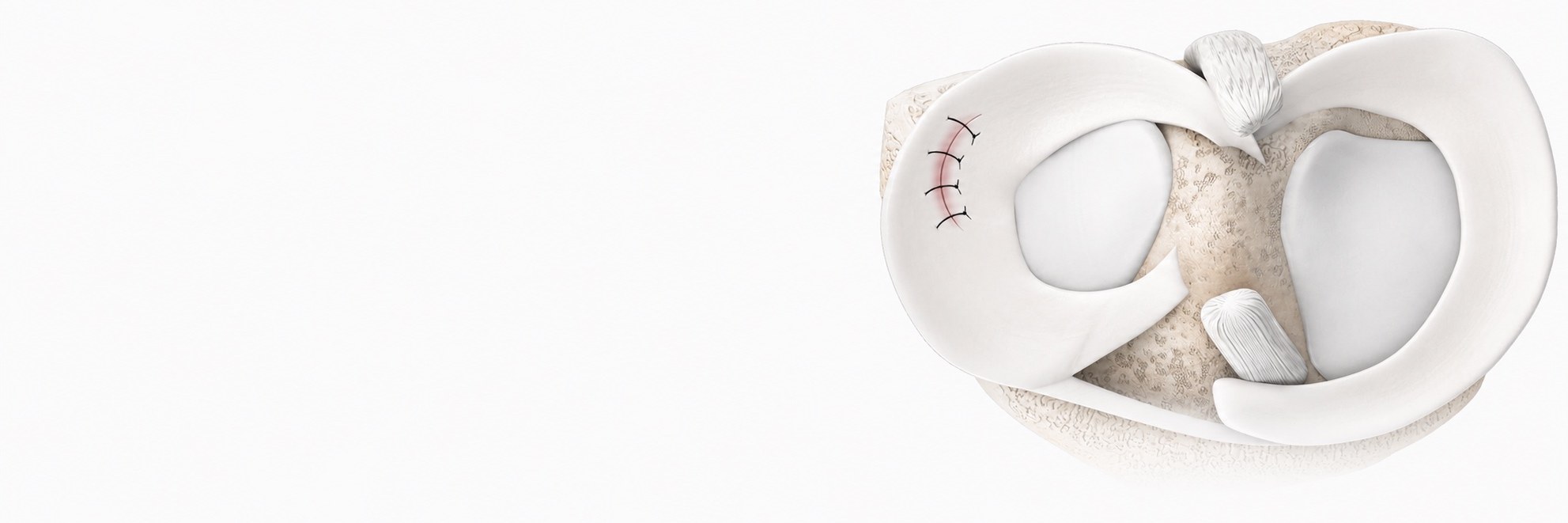
What is meniscus surgery?
Meniscus surgery is the arthroscopic treatment of a torn meniscus, the C-shaped pad of fibrocartilage between the femur and the tibia that distributes load and absorbs shock.
There are two main surgical options: meniscus repair (sewing the tear together to allow biological healing) and partial meniscectomy (selective removal of irreparable torn fragments). The choice depends on the tear pattern, the location of the tear and the patient profile.
When is meniscus surgery needed?
Surgery is generally recommended when:
- mechanical symptoms (locking, catching) are present
- the tear is repairable and the patient is young or active
- symptoms persist despite a structured period of conservative treatment
- the tear coexists with another injury that needs surgery (typically ACL)
Meniscus repair
For repairable tears, typically peripheral, longitudinal tears in good-quality tissue, sutures are placed across the tear to compress the edges together, allowing biological healing. Modern all-inside systems have made this technically reliable.
Repair preserves the full functional surface of the meniscus and is the preferred option whenever feasible. The protected rehabilitation period is longer (typically 6 weeks of restricted weight-bearing) but the long-term protection of the joint is significantly better.
Meniscus root repair
The meniscus root is the strong attachment of the meniscus to the bone at the front and back of the tibia. A root tear behaves biomechanically like a complete loss of the meniscus, the load distribution function is destroyed, and rapid joint degeneration can follow if it is not repaired.
Root repair is technically demanding. The torn root is reattached to the tibia through a small bone tunnel, using high-strength sutures pulled through and tied over a button on the front of the tibia. This restores the meniscus to its anatomic position and re-establishes the hoop-stress mechanism that protect the knee.
Patient selection is important. The best results are in younger patients with acute injuries, minimal cartilage damage and good alignment. In older patients with established arthritis, the long-term benefit is generally more modest.
Partial meniscectomy
For tears that cannot be repaired, typically degenerative, complex or central tears in poor tissue, the torn fragments are removed selectively while preserving as much healthy meniscal tissue as possible.
The aim is to relieve mechanical symptoms while maintaining the joint protection that the remaining meniscus provides. Recovery is faster than after repair, but the long-term loss of meniscus tissue accelerates joint degeneration.
How is the operation performed?
I perform meniscus surgery arthroscopically through small incisions, using specialised arthroscopic instruments inside the knee:
- a careful diagnostic examination of the entire joint
- identifying the exact tear pattern
- deciding between repair and selective resection based on the specific tear
- addressing any associated pathology (cartilage, ligament, plica)
What should the patient expect after surgery?
- most procedures are performed as a day case
- after meniscectomy: weight-bearing and activity progress quickly, often within days
- after meniscus repair: weight-bearing and deep knee flexion is restricted for 6 weeks to protect the repair
- physiotherapy begins early in both cases
- return to sport: typically 6–8 weeks after meniscectomy, 4–5 months after meniscus repair
What is the long-term outcome?
Outcomes after meniscus surgery are generally very good when the right procedure is matched to the right tear pattern. When successful, repair restores full meniscus function and is biomechanically the best option for the joint long-term.
Τι είναι η χειρουργική μηνίσκου;
Η χειρουργική μηνίσκου είναι η αρθροσκοπική αντιμετώπιση ενός σχισμένου μηνίσκου, του ινοχόνδρινου ιστού σε σχήμα C μεταξύ μηριαίου και κνήμης που κατανέμει το φορτίο και απορροφά κραδασμούς.
Υπάρχουν δύο κύριες χειρουργικές επιλογές: συρραφή μηνίσκου (συρραφή των άκρων της ρήξης για βιολογική επούλωση) και μερική μηνισκεκτομή (επιλεκτική αφαίρεση μη επιδιορθώσιμων τμημάτων).
Πότε χρειάζεται χειρουργική μηνίσκου;
Το χειρουργείο γενικά συνιστάται όταν:
- υπάρχουν μηχανικά συμπτώματα (κλείδωμα, μάγκωμα)
- η ρήξη είναι συρράψιμη και ο ασθενής είναι νέος ή δραστήριος
- τα συμπτώματα επιμένουν παρά συντηρητική αγωγή
- η ρήξη συνυπάρχει με άλλη κάκωση που χρειάζεται χειρουργείο (τυπικά ACL)
Συρραφή μηνίσκου
Σε συρράψιμες ρήξεις, τυπικά περιφερικές, επιμήκεις ρήξεις σε καλής ποιότητας ιστό, τοποθετούνται ράμματα για τη βιολογική επούλωση. Τα σύγχρονα συστήματα all-inside έχουν καταστήσει τη διαδικασία τεχνικά αξιόπιστη.
Η συρραφή διατηρεί τη λειτουργική επιφάνεια του μηνίσκου και είναι η προτιμητέα επιλογή.
Συρραφή ρίζας μηνίσκου
Η ρίζα του μηνίσκου είναι η ισχυρή πρόσφυσή του στο οστό στο πρόσθιο και οπίσθιο τμήμα της κνήμης. Μία ρήξη ρίζας συμπεριφέρεται βιομηχανικά σαν πλήρης απώλεια του μηνίσκου, η λειτουργία κατανομής φορτίου καταστρέφεται και η ταχεία φθορά της άρθρωσης ακολουθεί αν δεν αποκατασταθεί.
Η συρραφή ρίζας είναι τεχνικά απαιτητική. Η σχισμένη ρίζα επανακαθηλώνεται στην κνήμη μέσω μικρής οστικής σήραγγας, με ράμματα υψηλής αντοχής που τραβιούνται και δένονται πάνω από ένα κουμπί στην πρόσθια επιφάνεια της κνήμης. Αυτό αποκαθιστά τη φυσιολογική θέση του μηνίσκου και τις μηχανικές της δακτυλιοειδούς τάσης που προστατεύουν το γόνατο.
Η σωστή επιλογή ασθενούς έχει σημασία. Τα καλύτερα αποτελέσματα παρατηρούνται σε νεότερους ασθενείς με οξείες κακώσεις, ελάχιστη βλάβη χόνδρου και καλή ευθυγράμμιση. Σε ηλικιωμένους με προχωρημένη αρθρίτιδα, το μακροπρόθεσμο όφελος είναι πιο μέτριο.
Μερική μηνισκεκτομή
Σε ρήξεις που δεν επιδέχονται συρραφή, τα σχισμένα τμήματα αφαιρούνται επιλεκτικά διατηρώντας όσο το δυνατόν περισσότερο υγιή μηνισκικό ιστό.
Η ανάκαμψη είναι ταχύτερη από τη συρραφή, αλλά η μακροπρόθεσμη απώλεια μηνισκικού ιστού επιταχύνει τη φθορά της άρθρωσης.
Πώς γίνεται η επέμβαση;
Πραγματοποιώ τη χειρουργική μηνίσκου αρθροσκοπικά μέσω μικρών τομών:
- προσεκτική διαγνωστική εξέταση όλης της άρθρωσης
- αναγνώριση του ακριβούς προτύπου της ρήξης
- απόφαση μεταξύ συρραφής και επιλεκτικής αφαίρεσης
- αντιμετώπιση κάθε συνοδής παθολογίας
Τι αναμένεται μετά την επέμβαση;
- οι περισσότερες επεμβάσεις γίνονται ως αυθημερόν περιστατικό
- μετά από μηνισκεκτομή: η φόρτιση και η δραστηριότητα προοδεύουν γρήγορα
- μετά από συρραφή: η φόρτιση και η βαθιά κάμψη περιορίζονται για 6 εβδομάδες
- η φυσικοθεραπεία ξεκινά νωρίς
- επιστροφή στον αθλητισμό: 6–8 εβδομάδες μετά μηνισκεκτομή, 4–5 μήνες μετά συρραφή
Ποιο είναι το μακροπρόθεσμο αποτέλεσμα;
Τα αποτελέσματα είναι γενικά πολύ καλά όταν η σωστή επέμβαση επιλέγεται για τον σωστό τύπο ρήξης.