

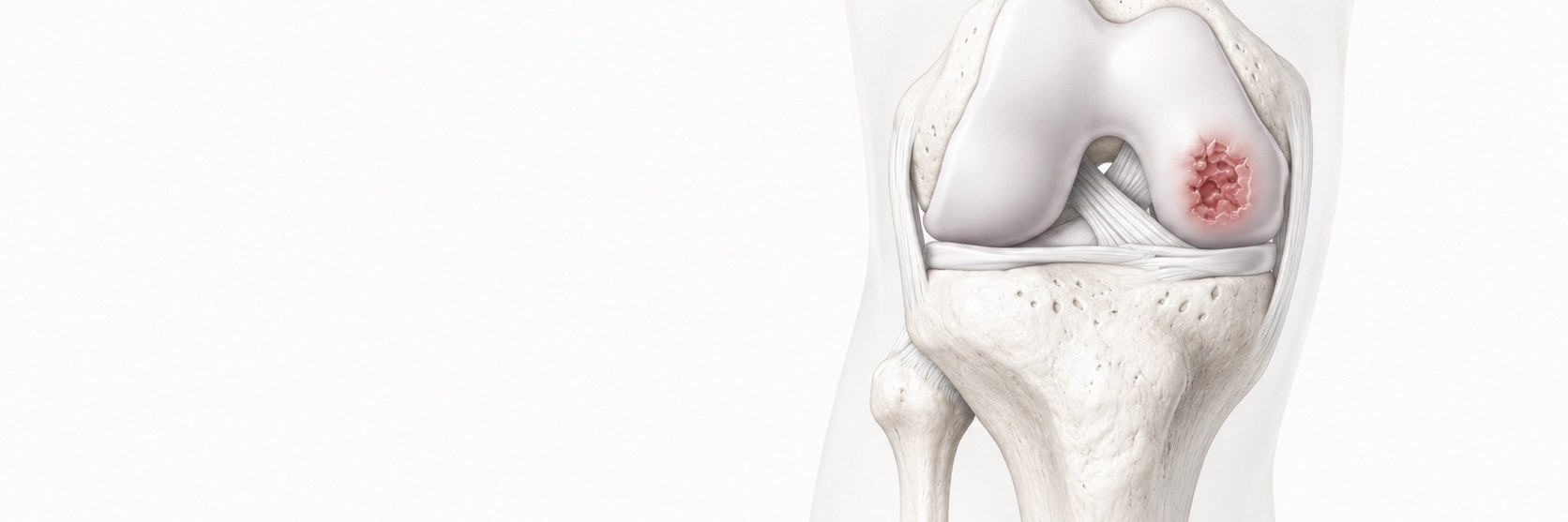
What is cartilage restoration?
Cartilage restoration is a group of surgical techniques designed to repair or replace damaged areas of articular cartilage in the knee. The goal is to restore the smooth, low-friction surface that allows the joint to move freely and and to protect the knee from progression to arthritis.
Modern techniques range from simple stimulation procedures (microfracture) to advanced biological restoration techniques (MACI, osteochondral autograft transfer). The right technique depends on the lesion size, depth, location and the patient’s age, activity level and goals.
When is cartilage restoration needed?
Cartilage restoration is considered in the following situations::
- a focal cartilage lesion is identified on imaging or arthroscopy
- symptoms persist despite conservative treatment
- the patient is young or middle-aged with many active years ahead
- the surrounding cartilage is healthy (focal damage, not widespread arthritis)
- any contributing malalignment or instability can be addressed simultaneously
What techniques are used?
For smaller lesions (under 2 cm²). Small holes are made in the underlying bone to release marrow stem cells, which form a fibrocartilaginous repair tissue. Simple, single-stage and effective for the right lesion.
For medium lesions. Microfracture is combined with a collagen scaffold that supports the repair process and produces more durable tissue than microfracture alone.
For larger lesions (2–10 cm²). A two-stage procedure: cartilage cells are harvested from the patient and grown on a scaffold in a laboratory, then implanted in a second operation. Produces cartilage with hyaline-like characteristics.
For deeper lesions involving both cartilage and underlying bone. Bone-and-cartilage plugs are transferred from a less-loaded part of the joint (autograft) or from a donor (allograft).
How is the operation performed?
Most cartilage restoration procedures are performed arthroscopically through small incisions, although some require a small open approach. The specific technique is chosen during the operation based on the true appearance of the lesion, sometimes different from the MRI appearance.
What should the patient expect after surgery?
Recovery depends on the technique used and the lesion location:
- protected weight-bearing for 6–8 weeks for most techniques
- a continuous passive motion (CPM) machine in the early weeks for some techniques
- physiotherapy starts immediately, focused initially on restoring motion before strength
- return to running typically at 6–9 months
- return to impact sport at 9–12 months, cartilage restoration requires long-term commitment
What is the long-term outcome?
Cartilage restoration outcomes vary by technique, lesion characteristics and patient factors:
- 70–85% of patients have substantial pain relief and functional improvement at 5 years
- MACI and AMIC produce more durable repair tissue than microfracture for larger lesions
- addressing malalignment alongside the cartilage work substantially improves outcomes
Τι είναι η αποκατάσταση χόνδρου;
Η αποκατάσταση χόνδρου είναι ομάδα χειρουργικών τεχνικών για την επιδιόρθωση ή αντικατάσταση κατεστραμμένων περιοχών αρθρικού χόνδρου στο γόνατο. Στόχος είναι η αποκατάσταση της λείας επιφάνειας και η προστασία του γόνατος από την εξέλιξη προς αρθρίτιδα.
Οι σύγχρονες τεχνικές κυμαίνονται από απλές διαδικασίες διέγερσης (microfracture) έως προηγμένες βιολογικές τεχνικές αποκατάστασης (MACI, οστεοχόνδρινα μοσχεύματα).
Πότε χρειάζεται αποκατάσταση χόνδρου;
Η αποκατάσταση χόνδρου εξετάζεται όταν:
- εντοπίζεται εστιακή χονδρική βλάβη στην απεικόνιση ή την αρθροσκόπηση
- τα συμπτώματα επιμένουν παρά τη συντηρητική θεραπεία
- ο ασθενής είναι νέος ή μέσης ηλικίας με πολλά ενεργά χρόνια μπροστά του
- ο περιβάλλων χόνδρος είναι υγιής (εστιακή βλάβη, όχι ευρεία αρθρίτιδα)
- οποιαδήποτε συνυπάρχουσα παραμόρφωση ή αστάθεια μπορεί να αντιμετωπιστεί ταυτόχρονα
Ποιες τεχνικές χρησιμοποιούνται;
Για μικρότερες βλάβες (κάτω από 2 cm²). Δημιουργούνται μικρές οπές στο υποκείμενο οστό για την απελευθέρωση βλαστοκυττάρων του μυελού, που σχηματίζουν ινοχόνδρινο ιστό επούλωσης.
Για μέτριες βλάβες. Το microfracture συνδυάζεται με ικρίωμα κολλαγόνου που υποστηρίζει τη διαδικασία επούλωσης.
Για μεγαλύτερες βλάβες (2–10 cm²). Επέμβαση δύο σταδίων: λαμβάνονται χονδροκύτταρα από τον ασθενή, καλλιεργούνται πάνω σε ικρίωμα στο εργαστήριο και εμφυτεύονται σε δεύτερη επέμβαση.
Για βαθύτερες βλάβες που αφορούν χόνδρο και υποκείμενο οστό. Κυλινδρικά μοσχεύματα οστού και χόνδρου μεταφέρονται από λιγότερο φορτιζόμενο μέρος της άρθρωσης (αυτομόσχευμα) ή από δότη.
Πώς γίνεται η επέμβαση;
Οι περισσότερες επεμβάσεις αποκατάστασης χόνδρου γίνονται αρθροσκοπικά μέσω μικρών τομών. Η συγκεκριμένη τεχνική επιλέγεται κατά τη διάρκεια της επέμβασης, με βάση την πραγματική εικόνα της βλάβης κατά την επέμβαση.
Τι αναμένεται μετά την επέμβαση;
Η ανάκαμψη εξαρτάται από την τεχνική και τη θέση της βλάβης:
- προστατευμένη φόρτιση για 6–8 εβδομάδες για τις περισσότερες τεχνικές
- συσκευή συνεχούς παθητικής κινητοποίησης (CPM) στις πρώτες εβδομάδες για ορισμένες τεχνικές
- η φυσικοθεραπεία ξεκινά αμέσως
- επιστροφή στο τρέξιμο τυπικά σε 6–9 μήνες
- επιστροφή σε αθλήματα υψηλής καταπόνησης σε 9–12 μήνες
Ποιο είναι το μακροπρόθεσμο αποτέλεσμα;
Τα αποτελέσματα ποικίλλουν με την τεχνική, τα χαρακτηριστικά της βλάβης και τους παράγοντες ασθενούς:
- 70–85% των ασθενών έχουν σημαντική ανακούφιση από τον πόνο και λειτουργική βελτίωση στα 5 έτη
- MACI και AMIC παράγουν πιο ανθεκτικό επανορθωτικό ιστό από microfracture για μεγαλύτερες βλάβες
- η ταυτόχρονη αντιμετώπιση παραμόρφωσης βελτιώνει σημαντικά τα αποτελέσματα